
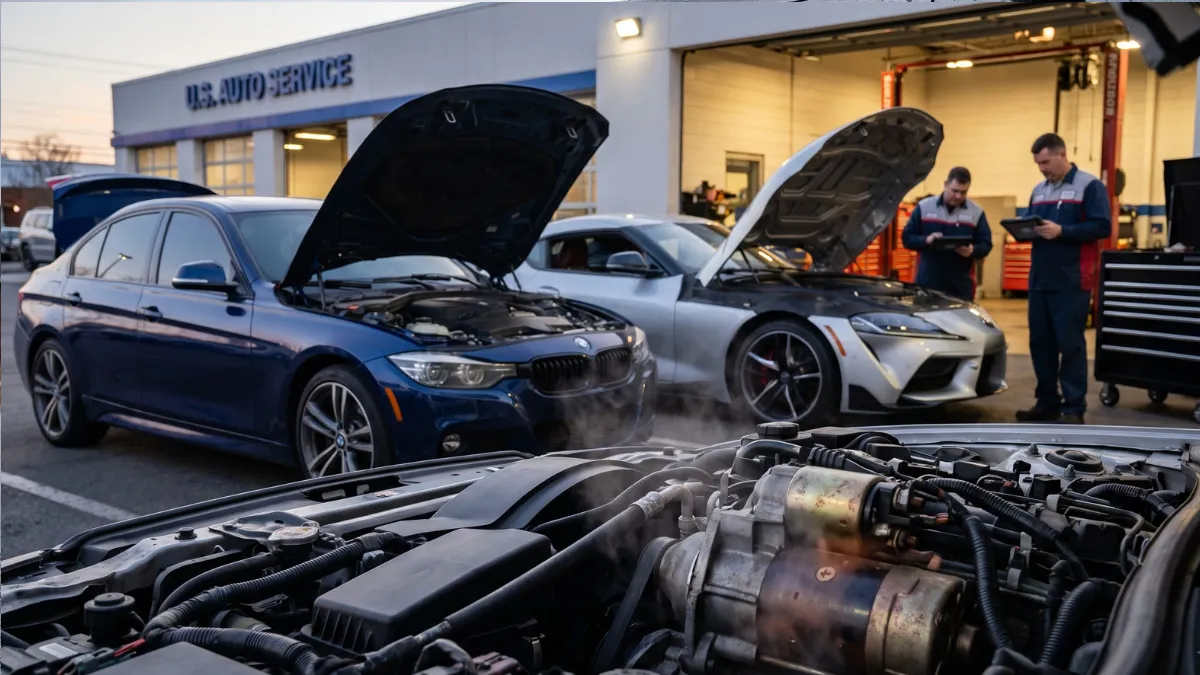
A starter problem can overheat in affected vehicles, creating a rare but serious fire hazard.
A starter motor that helps bring your engine to life can also create a fire risk in thousands of BMWs and Toyota Supras.
BMW of North America is recalling 87,394 vehicles in the U.S. over an engine-starter problem that can cause the starter to overheat and potentially start a fire. The recall includes certain BMW models and 2021–2023 Toyota Supra vehicles.
The federal recall, identified as NHTSA Campaign 26V056, covers vehicles from several model years and is tied to the electrical starter assembly.
Toyota separately says about 800 U.S. Supra vehicles fall under the recall. Dealers will replace the starter with an improved part at no cost.
The problem starts inside the starter
The affected starter contains an internal component that can experience unexpected wear.
That wear can cause the starter to malfunction. In an extreme case, the component can overheat enough to create a thermal event or fire while the driver is attempting to start the engine or while the engine is running.
That sounds frightening because the starter normally works for only a few seconds.
Think of it like a household appliance that should run briefly but develops an electrical fault and keeps generating heat. Most of the time, nothing happens. But if the conditions are right, that heat can become a much bigger problem.
BMW’s recall covers certain 2021–2023 X3 and X4 models, 2021–2024 330i and 430i models, 2021–2024 530i models, 2021–2022 Z4 models, and 2022–2023 230i models, along with the 2021–2023 Toyota Supra.
The exact affected vehicle depends on production date and configuration, so owners should use their VIN rather than relying only on the model name.
Why the Toyota Supra is involved
The Supra’s connection to BMW makes this recall particularly interesting.
The current-generation Supra shares major engineering and manufacturing relationships with BMW, including its engine and other mechanical components. That’s why a BMW starter issue can cross over into Toyota’s sports car lineup.
Toyota says certain 2021–2023 Supra vehicles can experience starter wear that prevents the engine from starting properly. In the worst-case scenario, the problem can create a thermal event or fire.
Toyota estimates roughly 800 U.S. Supras are affected by this particular 2026 recall.
That may sound small compared with recalls involving hundreds of thousands or millions of vehicles. But fire-related defects don’t become insignificant simply because the affected population is smaller.
What this means for owners
For most drivers, the biggest question is simple: Is my car affected?
The answer depends on the vehicle identification number.
NHTSA recommends using its recall lookup system to check a specific vehicle by VIN or license plate. The federal database can show whether a vehicle has an unrepaired safety recall.
BMW owners can also check open recalls through BMW’s recall system or the My BMW App. BMW says recall repairs are performed free of charge at authorized BMW centers.
Supra owners can use Toyota’s recall lookup service.
That’s important because a vehicle can look completely normal while carrying an open safety recall.
There may be no dramatic warning light, no obvious smoke and no strange noise until the problem actually develops.
The repair won’t cost owners anything
The good news is that affected owners aren’t expected to pay for the recall repair.
BMW dealers will replace the affected engine starter at no cost, according to the NHTSA recall documents. Toyota says its dealers will also replace the starter with an improved version without charging Supra owners.
That’s a significant protection for consumers.
Recall repairs aren’t ordinary maintenance. They address safety defects identified by the automaker or federal regulators.
NHTSA says manufacturers must remedy safety recalls, generally through repair, replacement, refund or, in rare cases, repurchase. The agency also says recall repairs are free at the manufacturer’s dealership.
For a luxury BMW owner, avoiding a potentially expensive electrical repair bill is another reason to act quickly.
This isn’t the first Supra fire-risk recall
The Supra has faced another starter-related fire recall recently.
In September 2025, Toyota recalled about 1,500 2020–2022 Supra vehicles because water could enter part of the engine starter in certain four-cylinder models. Corrosion could then cause a short circuit and increase the risk of fire.
That earlier recall involved a different mechanism from the 2026 starter recall.
The 2025 issue centered on water intrusion and corrosion. The newer recall involves unexpected wear inside the starter.
The two campaigns shouldn’t be treated as the same defect.
Still, the overlap is notable because it involves the same general component and the same potential consequence.
For Supra owners, checking recall records isn’t something to do once and forget.
BMW owners have reason to pay attention too
The current recall isn’t limited to the Supra.
BMW’s affected list spans multiple popular vehicles, including the 3 Series, 4 Series, 5 Series, X3, X4, Z4 and 2 Series Coupe. The combined U.S. population reaches 87,394 vehicles.
That gives the recall a much wider reach than the Supra figure alone suggests.
The affected BMW vehicles cover several model years, which means owners shouldn’t assume that a newer luxury vehicle is automatically outside the recall.
The safest approach is to check the VIN.
NHTSA warns that recently announced recalls may not immediately show every affected VIN in its public database because vehicle identification information gets added continuously.
That means checking again later can sometimes be worthwhile if you believe your vehicle may be affected.
Experts will watch the fire risk closely
The strongest concern is the potential consequence.
A starter malfunction that simply prevents a vehicle from starting would be inconvenient. A starter that can overheat and create a fire is a fundamentally different safety issue.
At the same time, owners shouldn’t assume every affected vehicle will catch fire.
The recall describes a potential fire risk, particularly in an extreme scenario. The existence of a recall doesn’t mean every vehicle will experience the defect or that every defective starter will produce flames.
That distinction matters.
The right response isn’t panic. It’s verification and repair.
And the technology involved is surprisingly compact.
A component small enough to sit within an engine compartment can carry enough electrical energy to crank a powerful gasoline engine. That tiny burst of energy is exactly why starter-related electrical failures deserve attention.
What happens next for owners
BMW and Toyota will continue notifying affected owners and directing them to dealers for the free repair.
If your vehicle appears in the recall database, don’t postpone the appointment simply because the car starts normally.
Follow the manufacturer’s instructions and ask the dealer whether any additional precautions apply to your specific vehicle.
NHTSA also encourages Americans to check their vehicles for open recalls regularly. The agency reported that more than 29 million vehicles were recalled in the U.S. during 2025, showing just how common safety campaigns can be across the industry.
For BMW and Supra owners, the important number isn’t 87,394.
It’s the 17-character VIN sitting on your dashboard.
A starter should only start your car—not give you another reason to worry about what happens under the hood.

About the Author
NewsDayPlus Editorial Team
The NewsDayPlus Editorial Team creates accurate, easy-to-understand content covering cars, motorcycles, electric vehicles, automotive technology, vehicle launches, prices, reviews, and industry news.
Our team researches information from reliable and official sources and aims to keep articles useful and up to date.
We are committed to accuracy, transparency, and reader-focused automotive journalism.
For corrections or editorial questions, please contact the NewsDayPlus team through our Contact Us page.
NewsDayPlus Editorial Team
NewsDayPlus.com