
Tesla’s private Austin launch is now colliding with a federal safety audit over whether its steering-wheel-free robotaxi belongs on American roads.
Tesla’s Cybercab is finally carrying passengers—and federal regulators are already investigating it.
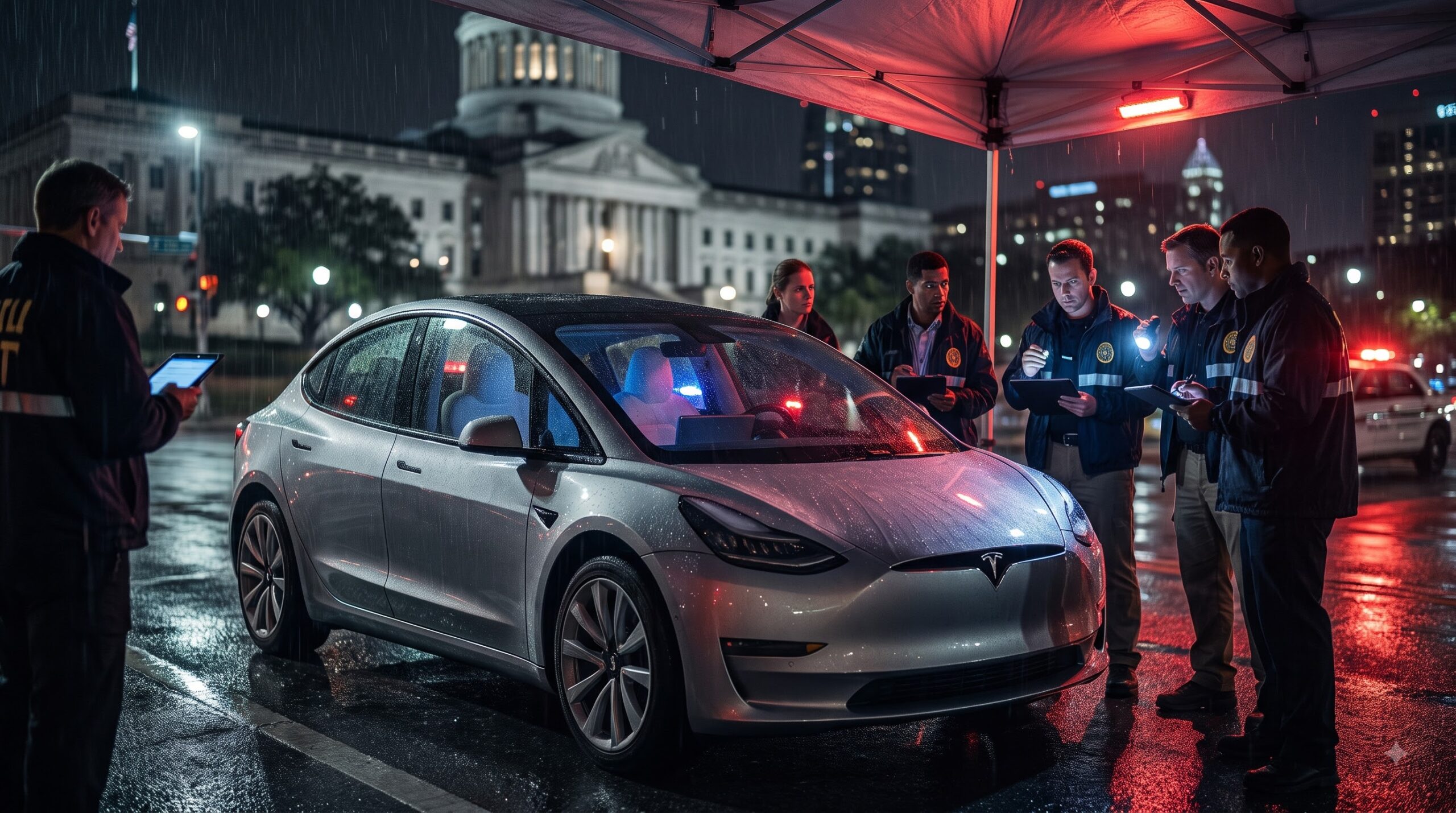
The Tesla Cybercab entered limited commercial service in Austin this week, but the launch immediately triggered an audit by the National Highway Traffic Safety Administration. The reason is impossible to ignore: this two-seat vehicle has no steering wheel, no accelerator pedal, no brake pedal, and no traditional mirrors.
A Quiet Launch With Enormous Stakes
Tesla chose a surprisingly private setting for one of the biggest moments in its history.
The company held an invite-only launch event in downtown Austin rather than staging the kind of massive livestreamed spectacle many Tesla fans expected. Reports described a limited audience, including invited shareholders and influencers, while Elon Musk himself did not take center stage.
Then the real story began.
Tesla started deploying Cybercabs through its Austin robotaxi network, putting a purpose-built autonomous vehicle on public roads without the controls Americans have considered essential since the earliest days of the automobile. Federal regulators quickly opened an Audit Query into Tesla’s certification process.
That distinction matters.
NHTSA has not announced that the Cybercab is defective. It has not ordered Tesla to stop operating the vehicles. Instead, the agency is examining how Tesla concluded that the Cybercab complies with applicable Federal Motor Vehicle Safety Standards despite its radically different design.
For the average American, this might sound like government paperwork.
It isn’t.
This is really a fight over a much bigger question: Who gets to decide when a computer is safe enough to replace the person behind the wheel?
Why the Cybercab Changes the Conversation
Most cars still follow a simple assumption.
Something goes wrong, and a human can grab the wheel, hit the brakes, or take control.
The Cybercab removes that backup plan.
Tesla’s vision is that the software handles the entire trip. You get in, choose your destination, and the vehicle does the driving. No steering wheel waits in front of you because, in Tesla’s ideal future, you won’t need one.
That’s the moment of genuine wonder here.
For more than a century, Americans have learned that a car requires someone to operate it. Now Tesla is asking people to sit inside a vehicle designed around the opposite idea: the car operates itself, and you simply ride.
It’s a little like stepping into an elevator for the first time and realizing there isn’t an operator pressing the buttons anymore. At first, that absence feels strange. Then, if the technology works, it becomes normal.
But roads are not elevator shafts.
American streets contain distracted drivers, cyclists, pedestrians, construction zones, sudden storms, flashing emergency lights, animals, potholes, and unpredictable human behavior. A robotaxi doesn’t get to choose an easier route through a controlled environment.
It has to survive reality.
Tesla has argued that its autonomous technology can make transportation safer and more affordable. The Cybercab represents the company’s biggest attempt yet to turn that promise into an everyday service.
What This Could Mean for Your Wallet and Daily Life
If Tesla succeeds, the Cybercab could eventually change how Americans think about transportation costs.
Imagine ordering a ride without paying for a human driver. Tesla believes removing the driver could dramatically reduce the cost of ride-hailing and make autonomous transportation available to more people.
That could matter to commuters, older Americans, people with disabilities, and families who spend thousands of dollars maintaining multiple vehicles.
For some households, a cheap autonomous ride could become more practical than owning a second car.
For others, it could create an uncomfortable new reality.
Millions of Americans make money driving. Ride-share drivers, taxi operators, delivery workers, and others depend on transportation jobs that automation could eventually disrupt.
That’s why the Cybercab isn’t just a technology story.
It’s also a jobs story.
If robotaxis become common, the same technology that makes rides cheaper for passengers could eliminate income for workers. Americans have seen this pattern before: automation often promises convenience first, while the economic consequences arrive later.
And there’s another question families will ask immediately.
Would you put your child inside one?
That may become the ultimate test of public acceptance.
People don’t judge transportation technology only with statistics. They judge it emotionally. A parent may understand that autonomous software could theoretically reduce accidents, but trusting a computer with a loved one requires something deeper than confidence in a presentation.
It requires trust earned mile by mile.
The first family that stops asking, “Can it drive itself?” and starts asking, “Why would I ever drive again?” will mark the real beginning of the robotaxi era.
The Safety Argument Is About More Than One Car
NHTSA’s audit puts Tesla at the center of a regulatory challenge the entire autonomous vehicle industry has been approaching for years.
Federal vehicle safety rules were largely written for a world where humans drive cars. Steering wheels, pedals, mirrors, and other equipment make sense when a person controls the vehicle.
They become harder to define when nobody does.
Tesla has taken the position that the Cybercab meets applicable standards through its self-certification process. NHTSA is now reviewing the technical data and reasoning behind that conclusion.
The government is also working through broader changes to safety rules as autonomous technology develops. That means the Cybercab could become an important test case for how quickly federal regulations adapt to vehicles that no longer resemble traditional cars.
Tesla isn’t the only company chasing driverless transportation.
Companies such as Waymo and Zoox have also pushed autonomous technology toward commercial deployment, but Tesla’s approach stands out because the Cybercab is designed without conventional manual controls from the start.
That creates a sharper regulatory confrontation.
You can think of it as trying to introduce a smartphone into a world where the rules still assume every phone has a rotary dial.
The technology may be ready before the rulebook is.
Or the technology may move too quickly, and the rules may exist for a reason.
Critics See Risk. Tesla Sees the Future.
Tesla supporters see the Austin launch as exactly the kind of bold move America needs.
They argue that regulators shouldn’t force autonomous vehicles to keep outdated equipment simply because human drivers once needed it. If software can safely perform the task, they say, the vehicle should evolve around that new reality.
Critics aren’t convinced.
Safety experts and skeptics have questioned whether Tesla’s camera-focused approach can reliably handle difficult conditions and unpredictable situations. Tesla’s broader autonomous-driving technology has also faced previous federal scrutiny, giving regulators and the public reasons to demand proof rather than promises.
Both sides agree on one thing: the stakes are enormous.
If autonomous vehicles genuinely reduce crashes, delaying them could cost lives. But if companies deploy them before the technology is ready, rushing could create a different kind of danger.
That’s the tension surrounding Austin right now.
Innovation wants speed.
Safety demands evidence.
What Happens Next Could Define the Robotaxi Industry
The next major development will come from NHTSA’s review of Tesla’s certification process.
The agency will examine the information and technical basis Tesla used when it declared the Cybercab compliant with applicable federal standards. The outcome could shape Tesla’s expansion plans and influence how other autonomous vehicle companies approach future launches.
For now, the Austin rollout remains limited, with reports indicating that dozens of Cybercabs are registered in Texas while Tesla plans broader expansion over time.
Investors are watching closely too.
Tesla’s stock fell sharply after the launch and regulatory news, reflecting concerns that the company still faces major questions about how quickly the Cybercab can scale beyond a controlled rollout.
But the bigger story isn’t what happens to Tesla’s stock tomorrow.
It’s what happens to American roads over the next decade.
Austin may be only one city, and the Cybercab fleet may still be small. Yet the experiment now unfolding there could help determine whether the next generation of Americans learns to drive—or simply learns where to tell the car to go.
The Cybercab’s most important journey isn’t across Austin—it’s across the line between science fiction and everyday American life.

About the Author
NewsDayPlus Editorial Team
The NewsDayPlus Editorial Team creates accurate, easy-to-understand content covering cars, motorcycles, electric vehicles, automotive technology, vehicle launches, prices, reviews, and industry news.
Our team researches information from reliable and official sources and aims to keep articles useful and up to date.
We are committed to accuracy, transparency, and reader-focused automotive journalism.
For corrections or editorial questions, please contact the NewsDayPlus team through our Contact Us page.
NewsDayPlus Editorial Team
NewsDayPlus.com