
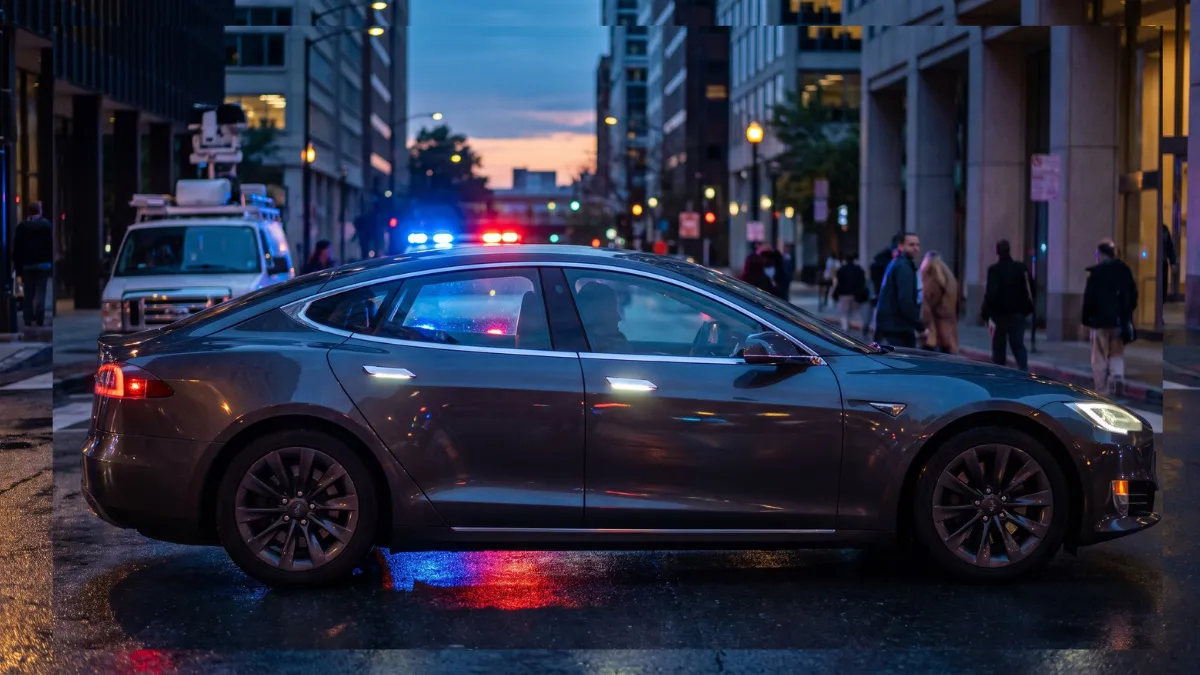
Nearly 3 million Teslas are caught in China’s record recall over emergency door access concerns.
Tesla’s sleek door handles are suddenly at the center of a huge safety debate.
China is recalling about 2.98 million Tesla vehicles over concerns that electronic door handles may make emergency exits harder to use when a vehicle loses power. The recall forms part of a record 4.3-million-vehicle action involving Tesla and eight other automakers.
Why Tesla’s Door Handles Are Under Scrutiny
The problem involves a design feature that Tesla helped popularize: flush or recessed exterior door handles that sit almost flat against the vehicle’s body.
They look clean and futuristic. But in an emergency, regulators are asking a much simpler question: Can someone open the door quickly when the car has no power?
That question matters because electronic systems can behave differently after a serious crash, battery failure or other electrical problem. A handle that normally works with the touch of a finger may become far less intuitive when the vehicle’s electronics aren’t functioning normally.
China’s recall requires affected automakers to address concerns involving emergency door-release access. Some remedies include clearer instructions and software changes designed to improve emergency operation.
For Tesla owners in America, there’s an important distinction.
This particular massive recall is happening in China, not as a newly announced U.S. recall. Reuters reports that European regulators are monitoring the issue, while the Dutch vehicle regulator says there is currently no Tesla recall in Europe related to these concerns.
That doesn’t make the story irrelevant to American drivers.
Tesla sells globally, and safety standards established in one major market can influence vehicle designs everywhere.
The Human Problem Behind the Technology
Imagine you’re trapped inside your house during a power outage.
You know where the front door is. You know how to open it. You don’t need to remember a special sequence or search for an emergency instruction label.
That’s essentially the challenge regulators are raising with increasingly electronic vehicle controls.
A car door isn’t just another piece of technology. It’s an escape route.
If a crash damages electrical systems, passengers may have only seconds to understand what they’re supposed to do. Children, older adults and frightened passengers may struggle even more if the normal controls don’t work as expected.
China’s recall comes after concerns that some electronic handles can become difficult to locate or operate during emergencies. Reuters reports that the issue has also drawn attention from safety experts and regulators outside China.
And there’s a striking detail here: a tiny door handle can become a critical safety component when everything else goes wrong.
That’s the paradox of modern cars.
The technology that makes a vehicle feel effortless during normal driving can become surprisingly important during the few seconds when normal driving has completely stopped.
What This Could Mean for American Tesla Owners
If you drive a Tesla in the United States, don’t assume this China recall means your vehicle has suddenly been recalled here.
There is currently no evidence in the sources reviewed for this article that the same large-scale door-handle recall has been announced for Tesla vehicles in the U.S. Tesla maintains its own recall information page, and owners can also check their vehicle through federal recall databases.
Still, American owners have a reason to pay attention.
The National Highway Traffic Safety Administration has already investigated complaints involving Tesla electronic door handles. In a 2025 preliminary evaluation, NHTSA identified an estimated 174,290 Model Y vehicles in an investigation involving electronic door handles becoming inoperative because of low 12-volt battery voltage. The agency received reports involving owners who couldn’t reopen doors to access children after exiting the vehicle.
That doesn’t mean the U.S. investigation and China’s current recall are the same action.
They aren’t.
But they involve a similar underlying question: What happens when an electronic door system doesn’t work the way a driver expects?
For families, that’s not an abstract engineering debate.
It can affect how confidently you can get a child out of a vehicle, how quickly you can leave after a crash, and whether other people know how to help you.
The Bigger Debate: Innovation Versus Simplicity
Critics of Tesla’s door-handle design argue that automakers shouldn’t make emergency controls harder to understand just to create a cleaner exterior.
Their concern is simple: emergency controls should be obvious, physical and intuitive.
Tesla supporters can make an equally reasonable argument.
Electronic systems allow automakers to create cleaner designs, improve aerodynamics and integrate vehicle functions in ways that weren’t possible with traditional mechanical handles. Tesla also provides emergency-release procedures for its vehicles, and many modern cars rely on electronics for critical functions.
The disagreement isn’t really about whether technology belongs in cars.
It’s about where manufacturers should draw the line.
A feature can be brilliant during normal use and still deserve scrutiny when conditions become extreme.
China is taking that concern seriously. The country plans to prohibit certain minimalist concealed door-handle designs on new vehicles beginning in 2027, according to Reuters.
That could eventually influence global vehicle design.
What Happens Next
The biggest thing to watch is whether regulators in the United States and Europe take additional action.
European regulators are already discussing emergency door accessibility, while the United Nations vehicle-regulation process and Euro NCAP are also examining the issue. The Dutch regulator says vehicle doors should remain intuitively accessible during emergencies, including electrical failures.
In the United States, NHTSA’s previous investigation adds another layer to the story.
American Tesla owners should check their VIN for open recalls rather than relying on headlines about vehicles in another country. NHTSA’s recall database lets owners search by VIN or license plate and see whether their specific vehicle has an unrepaired recall.
Tesla also says recall-related service is provided at no charge when a vehicle is included in a recall.
The larger question will follow Tesla far beyond this week’s headlines.
As automakers add more software, sensors and electronic controls, regulators will increasingly judge not only what a vehicle can do when everything works, but also what happens when something fails.
The future of the car may be brilliantly electronic, but the emergency exit still has to work when the power goes out.

About the Author
NewsDayPlus Editorial Team
The NewsDayPlus Editorial Team creates accurate, easy-to-understand content covering cars, motorcycles, electric vehicles, automotive technology, vehicle launches, prices, reviews, and industry news.
Our team researches information from reliable and official sources and aims to keep articles useful and up to date.
We are committed to accuracy, transparency, and reader-focused automotive journalism.
For corrections or editorial questions, please contact the NewsDayPlus team through our Contact Us page.
NewsDayPlus Editorial Team
NewsDayPlus.com