
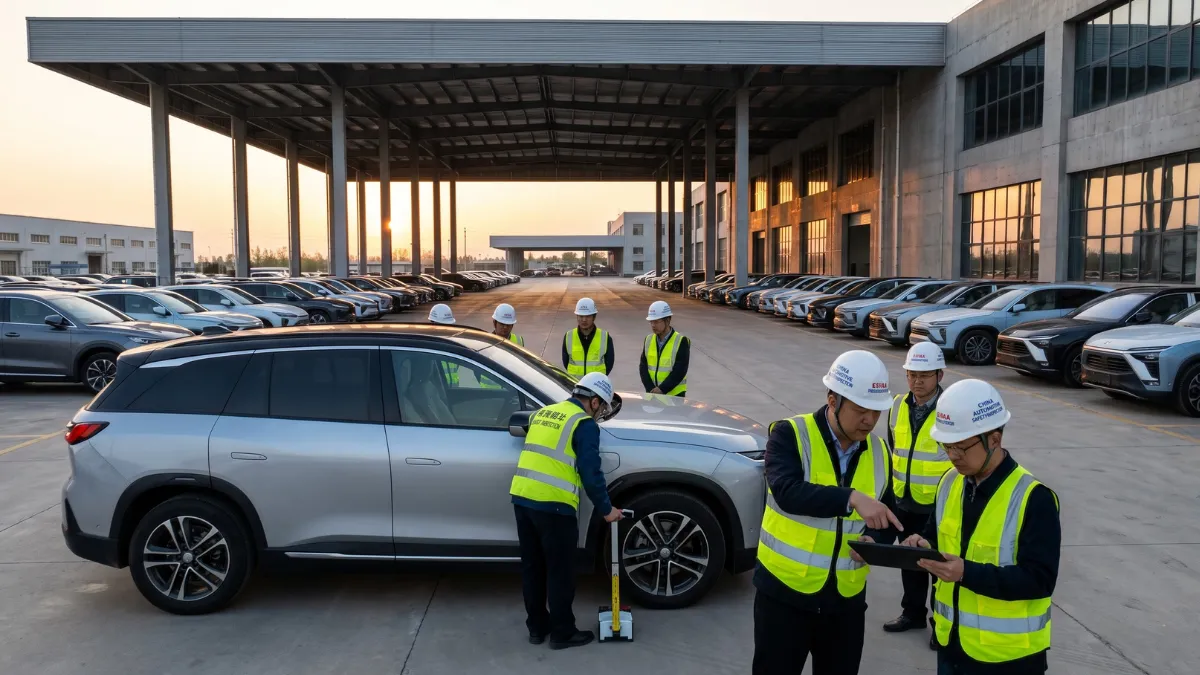
Beijing is demanding deeper safety checks after a record recall involving 4.3 million vehicles.
China is tightening its grip on vehicle safety right now, and the move could reshape the global auto industry.
Chinese regulators are launching a year-long vehicle-quality campaign after Tesla and eight other automakers announced fixes affecting roughly 4.3 million vehicles over concerns about emergency door-release systems. The new campaign goes far beyond door handles, targeting everything from vehicle durability to advanced driver-assistance and autonomous-driving technology.
China’s auto industry faces a new safety test
The crackdown requires automakers to conduct broad inspections of their vehicles, including product quality, reliability, durability and the testing of new technologies.
Companies must report their findings to local authorities by the end of 2026. If they uncover defects, regulators expect manufacturers to promptly submit recall plans and take action.
That represents a significant shift for the world’s largest auto market.
China’s electric-vehicle industry has spent years racing to introduce longer range, faster charging, advanced software and increasingly automated driving features. Now regulators are asking a tougher question: Can all that technology remain safe when something goes wrong?
The immediate trigger is a record recall announced last week. Tesla and eight Chinese automakers are addressing concerns that emergency door-release mechanisms could be difficult to locate or operate after a crash or electrical failure.
Tesla accounts for about 2.98 million vehicles in that recall, while the combined action covers approximately 4.3 million vehicles.
Why American drivers should care
You might be wondering why a Chinese vehicle-safety campaign matters if you drive a Ford, Toyota or Tesla in the United States.
The answer is simple: modern cars are global products.
A safety rule developed in one major market can influence how automakers design vehicles everywhere. China is also an enormous market for global manufacturers, giving its regulators unusual leverage over vehicle design and engineering decisions.
The door-handle controversy is a good example.
Flush electronic handles became popular because they give vehicles a sleek appearance and can improve aerodynamics. But regulators are now examining what happens when the battery or electrical system stops working.
It’s similar to putting a smart lock on your front door. It may be more convenient every day, but you’d want to know exactly what happens when the power goes out.
That basic question is becoming a serious issue for the auto industry.
China has already announced that new vehicles will face restrictions on concealed door-handle designs beginning in 2027. The country is also moving toward tighter requirements around emergency access and vehicle safety technology.
The human stakes are much bigger than a recall notice
For drivers, safety isn’t an abstract engineering concept.
If you’re carrying your kids to school, driving to work or taking your family on a road trip, you expect the doors to work when you need them most. In a serious crash or fire, a few seconds can matter enormously.
That’s why emergency door access has attracted so much attention.
Chinese state media previously reported an incident involving a Xiaomi SU7 in which the driver died after a crash and fire, while people outside reportedly struggled to open the doors. Similar concerns have appeared in complaints and lawsuits involving vehicles in other markets.
The current recall doesn’t mean every vehicle involved is dangerous.
It means regulators and manufacturers have identified a potential problem with a system that becomes especially important during an emergency.
And the new Chinese campaign reaches much further.
Regulators want automakers to examine advanced driver-assistance systems, autonomous-driving technology, cybersecurity, data security, software updates, incident monitoring and emergency response.
That matters because today’s car can receive software updates much like your phone.
But unlike a phone, a car can travel 70 miles per hour with a family inside.
Critics see a warning; the industry sees progress
Critics argue that China’s rapid EV expansion has sometimes prioritized speed, styling and new features over careful safety validation.
That criticism has some force. China’s auto market has become fiercely competitive, with manufacturers racing to launch new models and technologies while prices fall and consumer expectations rise.
The China Association of Automobile Manufacturers has itself warned that irrational competition could damage production consistency and vehicle safety.
But there’s another way to read the crackdown.
Finding a problem and fixing it can be evidence that a safety system is working.
Regulators aren’t simply telling automakers to stop innovating. They’re demanding that companies prove new technologies can survive real-world conditions.
That distinction matters.
China’s campaign could ultimately make vehicles safer if manufacturers take the audits seriously and use the findings to improve engineering before problems reach customers.
There’s also a geopolitical twist.
For decades, American and European regulators often set the tone for global vehicle-safety rules. Now China is moving aggressively into that space, particularly as it becomes the world’s dominant EV market. Reuters reports that electric vehicles account for nearly 55% of new-car sales in China.
That is a remarkable change.
The country that became the world’s biggest EV manufacturing powerhouse is now trying to become a rule-maker for the technology as well.
What happens next
The next year could reveal whether this is a temporary response to a huge recall or the beginning of a much tougher era for China’s auto industry.
Automakers must complete their self-inspections and submit reports to authorities by the end of 2026. Regulators will also scrutinize the safety validation behind advanced driver-assistance and autonomous-driving systems.
American regulators are watching similar issues.
The National Highway Traffic Safety Administration has considered concerns about emergency door releases and electronic vehicle controls, while European regulators are also examining how vehicles should provide intuitive emergency access when electrical systems fail.
For American consumers, the lesson is useful even if your vehicle isn’t affected by this recall.
When you’re shopping for a new car, don’t just ask how fast it accelerates or how many miles it gets on a charge. Ask how its safety systems behave when the power disappears, the software fails or a crash changes everything.
The smartest car isn’t necessarily the one with the most technology.
The real test of a high-tech car is what it does when everything goes wrong.

About the Author
NewsDayPlus Editorial Team
The NewsDayPlus Editorial Team creates accurate, easy-to-understand content covering cars, motorcycles, electric vehicles, automotive technology, vehicle launches, prices, reviews, and industry news.
Our team researches information from reliable and official sources and aims to keep articles useful and up to date.
We are committed to accuracy, transparency, and reader-focused automotive journalism.
For corrections or editorial questions, please contact the NewsDayPlus team through our Contact Us page.
NewsDayPlus Editorial Team
NewsDayPlus.com