
Buffett’s Passive Investing Pick: Why He Recommends VOO -Buffett’s Berkshire gained 5.5 million percent — yet he tells most investors to skip stock-picking and buy one simple ETF instead. Here’s what and why.
2. EXECUTIVE NEWS SUMMARY
Warren Buffett, chairman of Berkshire Hathaway, has endorsed passive index investing for ordinary investors since at least 1993, specifically recommending the Vanguard S&P 500 ETF (VOO). Despite outperforming the broader market over six decades, Buffett argues that low fees, consistent contributions, and long-term holding make passive indexing the smarter path for most Americans building wealth.
3. FEATURED SNIPPET ANSWER
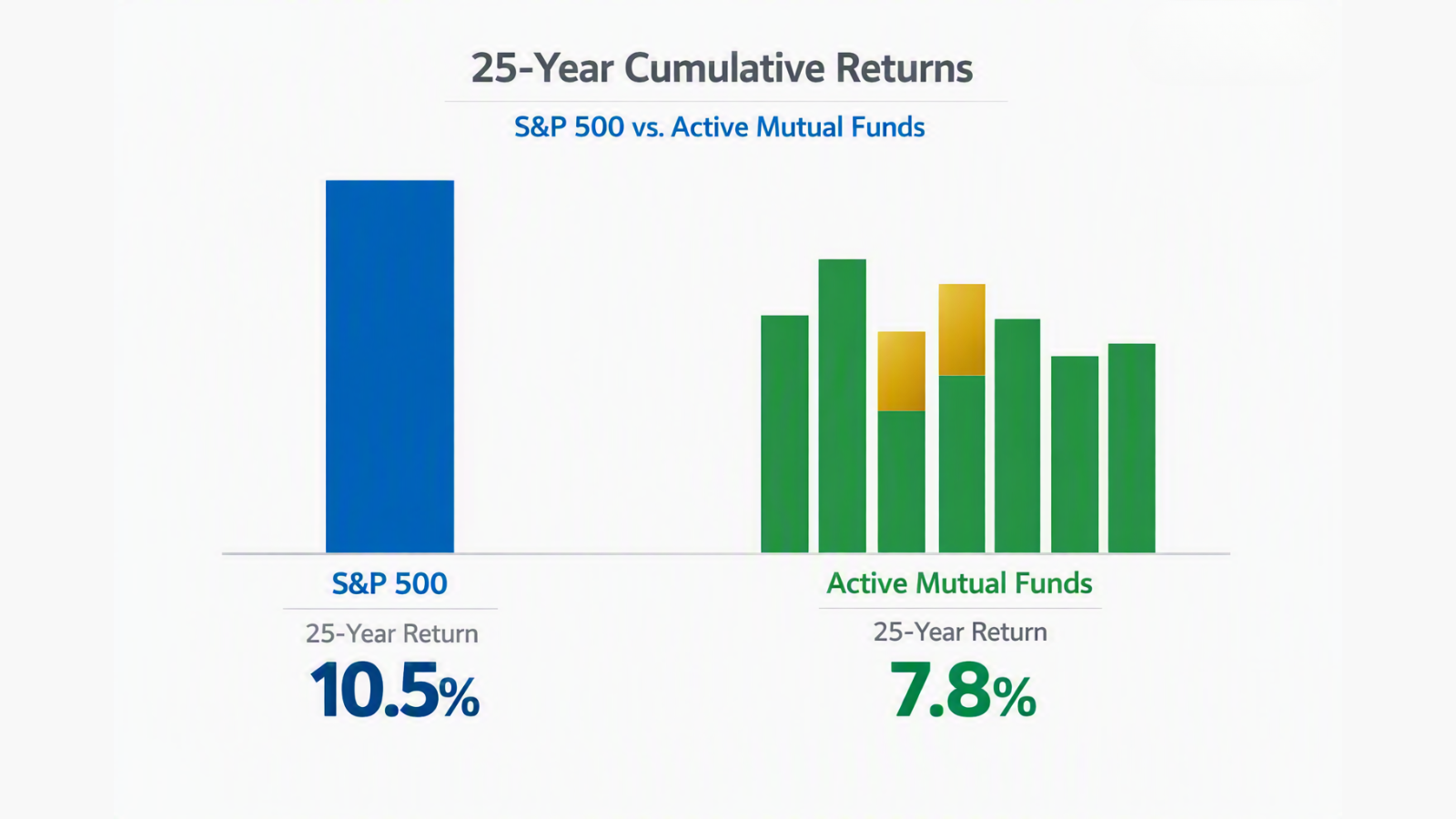
Warren Buffett recommends that most investors buy a low-cost S&P 500 index fund — specifically the Vanguard S&P 500 ETF (VOO), which carries an expense ratio of just 0.03%. His reasoning: active fund managers consistently underperform the index over time, and lower fees let investors keep more of their gains while growing wealth steadily over decades.
4. MAIN ARTICLE
Word Count Target: 1,200–1,800 words
Warren Buffett Has Beaten the Market for 60 Years — and Says You Shouldn’t Even Try
Warren Buffett built one of the most extraordinary track records in financial history. Berkshire Hathaway gained 5,502,284% during his six-decade tenure at the helm, dwarfing the S&P 500’s 39,054% return over the same span.
Yet the man who did it says most Americans should not attempt anything close.
Buffett’s advice for ordinary investors is straightforward and has not changed in more than 30 years: buy a low-cost S&P 500 index fund, add money consistently, and hold through every market cycle.
What Happened?
Buffett has been recommending passive index investing since at least 1993 — 17 years before the Vanguard S&P 500 ETF (VOO) even came to market. At that year’s Berkshire Hathaway annual shareholders meeting, he stated that index funds had delivered better results for shareholders than Wall Street professionals as a whole.
His position has only grown more emphatic with time.
In his 2013 shareholder letter, Buffett disclosed his instructions for the trust that would hold cash for his wife after his death: put 10% in short-term government bonds and 90% in a very low-cost S&P 500 index fund, with Vanguard’s as his specific suggestion.
That letter gave the investment world a rare, unambiguous window into how the world’s most celebrated stock-picker thinks ordinary people should invest.
Background & Context
Buffett’s endorsement of passive investing did not emerge in a vacuum. It reflects a body of data that has accumulated over decades.
S&P Global publishes an annual scorecard measuring how large-cap, actively managed funds perform against the S&P 500. The results are stark: over the past 25 years, only three years saw a majority of active funds outperform the index. Two of those years were 2007 and 2009 — when the market fell sharply due to the mortgage crisis.
The implication is clear. Active managers tend to look best during downturns, when skilled selection of less-exposed stocks can edge out a falling index. But the market rises the vast majority of the time, and in rising markets, most active managers lose ground to the index after fees.
Buffett made his clearest public demonstration of this thesis in 2007, when he bet that a straightforward investment in the S&P 500 would beat a professionally curated basket of hedge funds over ten years. He won that bet in 2017.
The Vanguard S&P 500 ETF itself launched in 2010. Berkshire Hathaway held a position in VOO for several years before closing it out in the fourth quarter of 2025.
Official Statements & Reaction
Buffett has been consistent and unambiguous across multiple public forums.
At the 1993 Berkshire Hathaway shareholders meeting, he said: “Index funds, overall, have delivered for shareholders a result that has been better than Wall Street professionals as a whole.”
His 2013 shareholder letter went further, giving a rare two-part rationale. He cited his belief that index investing would outperform other instruments, and pointed to low fees as the second key driver of his recommendation.
Buffett has also addressed the practical reality of most retail investors. He noted that most people have day jobs and are not spending their hours analyzing individual companies the way professional investors do — making index funds the most practical and effective vehicle for long-term wealth building.
Expert Analysis & Economic/Social Impact
Buffett’s recommendation carries unusual weight because it runs against his own business interest. Berkshire Hathaway’s success was built on deep fundamental analysis, stock concentration, and long-term holding — skills that take decades to develop and are nearly impossible to replicate.
Buffett himself has acknowledged that it’s unlikely even Berkshire Hathaway could replicate its own historic gains at this stage, given the scale at which it now operates.
By steering retail investors toward index funds, he is essentially saying: the game I have played for 60 years is not one you can win, and you do not need to win it.
That framing matters. Many retail investors enter markets believing that research, timing, or intuition can beat professional fund managers. The data consistently says otherwise.
The Vanguard S&P 500 ETF carries an expense ratio of 0.03% — among the lowest available for any ETF. Over a 30-year investment horizon, the difference between a 0.03% expense ratio and a 1% actively managed fund fee compounds into a meaningful gap in final portfolio value.
Opposing Views & Key Debates
Supporters argue that passive investing democratizes wealth building. It removes the need for financial expertise, minimizes trading costs and tax drag, and allows any investor with a long time horizon to participate in the economy’s long-run growth. Buffett’s own data — the S&P 500 bet, the S&P Global scorecard — supports this view.
Critics contend that passive investing works best in rising markets but can expose investors to full downside during crashes with no active risk management. They also argue that as more money flows into index funds, markets may become less efficient, potentially reducing the informational advantage that makes indexing work.
There is also a nuanced view from within the value investing community: Buffett himself is the most famous argument against passive investing. The implication of his personal track record is that extraordinary investors do exist, even if they are rare.
Who Is Affected?
Retail investors and savers are the direct audience for Buffett’s advice. His recommendation points specifically to people who lack the time, tools, or expertise to analyze individual equities.
Retirees and near-retirees building on a long horizon benefit most from low-cost index exposure. Even modest consistent contributions to VOO over 20 to 30 years produce substantial returns due to compound growth.
Active fund managers are implicitly challenged by Buffett’s position. His endorsement of passive products over managed funds reinforces S&P Global’s data showing systematic underperformance by professional stock-pickers.
Young investors entering the market face a particularly clear decision. With decades of compounding ahead, the cost advantages of VOO’s 0.03% expense ratio widen substantially over time.
Key Data & Statistics
| Metric | Figure |
| Berkshire Hathaway total gain (Buffett era) | 5,502,284% |
| S&P 500 gain (same period) | 39,054% |
| VOO expense ratio | 0.03% |
| VOO assets under management | $1.7 trillion |
| VOO dividend yield | 1.07% |
| Years active funds beat S&P 500 (last 25) | 3 out of 25 |
| Buffett’s market-vs-hedge-fund bet duration | 2007–2017 |
| Buffett’s 2013 recommendation ratio | 90% S&P 500, 10% short-term bonds |
What Happens Next?
Buffett’s passive investing advice is not tied to a single policy decision or deadline — it is a long-standing investment philosophy. Several near-term dynamics make it newly relevant.
The S&P 500 is currently trading at elevated valuations by historical measures, prompting debate about whether now is still a sound entry point for index investors. Buffett’s framework does not rely on market timing; it relies on consistent participation over time.
VOO currently trades at approximately $686 per share as of August 2, 2026, with a year-to-date gain reflecting the broader market’s recovery from earlier 2026 volatility.
The fourth quarter 2025 closure of Berkshire Hathaway’s own VOO position sparked interest from analysts. Berkshire’s exit likely reflects portfolio management at scale rather than a change in Buffett’s underlying advice to retail investors, given that Berkshire operates very differently from a personal retirement account.
Key Takeaways
- Warren Buffett has recommended S&P 500 index investing for retail investors since at least 1993, long before VOO existed.
- His 2013 shareholder letter specified that money held in trust for his wife should be invested 90% in a low-cost S&P 500 fund, with Vanguard as his explicit suggestion.
- Over 25 years, actively managed large-cap funds beat the S&P 500 in only three years, according to S&P Global data.
- Buffett won a 10-year bet in 2017 proving that a simple S&P 500 investment would beat a basket of hedge funds.
- VOO’s expense ratio of 0.03% is among the lowest available for any ETF, directly addressing Buffett’s emphasis on fee minimization.
Frequently Asked Questions
What ETF does Warren Buffett recommend for most investors?
Buffett specifically recommends the Vanguard S&P 500 ETF (VOO). He has cited its low expense ratio of 0.03% and its long-term track record of outperforming actively managed funds as his primary reasons.
Why does Warren Buffett recommend passive investing if he beat the market himself?
Buffett argues that his approach requires full-time analysis and decades of specialized expertise that most retail investors neither have nor need. He says passive indexing is sufficient to build significant wealth over a long time horizon.
What is the expense ratio on VOO?
The Vanguard S&P 500 ETF carries an expense ratio of 0.03%, which is among the lowest available for any exchange-traded fund.
Did Warren Buffett ever make a bet about index funds vs. active management?
Yes. In 2007, Buffett bet that a straightforward S&P 500 investment would beat a professionally selected basket of hedge funds over a decade. He won that bet when it concluded in 2017.
How often do actively managed funds beat the S&P 500?
According to S&P Global’s annual scorecard, over the past 25 years, a majority of large-cap actively managed funds only outperformed the S&P 500 in three years — two of which coincided with the 2007–2009 market crash.
What is Warren Buffett’s recommended asset allocation for ordinary investors?
In his 2013 shareholder letter, Buffett advised putting 90% of investable cash into a low-cost S&P 500 index fund and 10% into short-term government bonds.
Does Warren Buffett own VOO personally?
Berkshire Hathaway held a position in VOO for several years, though it closed that position in the fourth quarter of 2025. Buffett’s personal recommendation for VOO applies to retail investors, not to Berkshire’s institutional-scale portfolio.
External Authoritative Sources
- S&P Global SPIVA Scorecard — spglobal.com/spdji/en/research-insights/spiva/
- SEC Investor Bulletin: Index Funds — investor.gov
- Berkshire Hathaway Annual Shareholder Letters — berkshirehathaway.com/letters/letters.html
- Vanguard VOO Fund Overview — vanguard.com

About the Author
Aparna is the founder and editor of NewsDayPlus, where he covers breaking U.S. news, Social Security updates, finance, stock market trends, technology, consumer affairs, and major national events. He researches information from official government agencies, company announcements, and reputable news sources to produce accurate, fact-checked, and reader-friendly articles. His mission is to make complex topics simple, reliable, and useful for everyday readers across the United States.