
JD Wetherspoon Issues Fourth Profit Warning in Seven Months — What It Means for Investors and Consumers
JD Wetherspoon has issued its fourth profit warning in just seven months, raising fresh concerns about the health of the UK hospitality sector and the pressure facing consumer-facing businesses in 2026.
The pub chain said higher labor costs, increased taxes, and softer customer spending are expected to reduce annual profits, despite continued growth in sales. The update sent Wetherspoon shares lower and drew attention from investors watching how inflation and wage increases are affecting restaurants, bars, and pubs across Britain. The Guardian
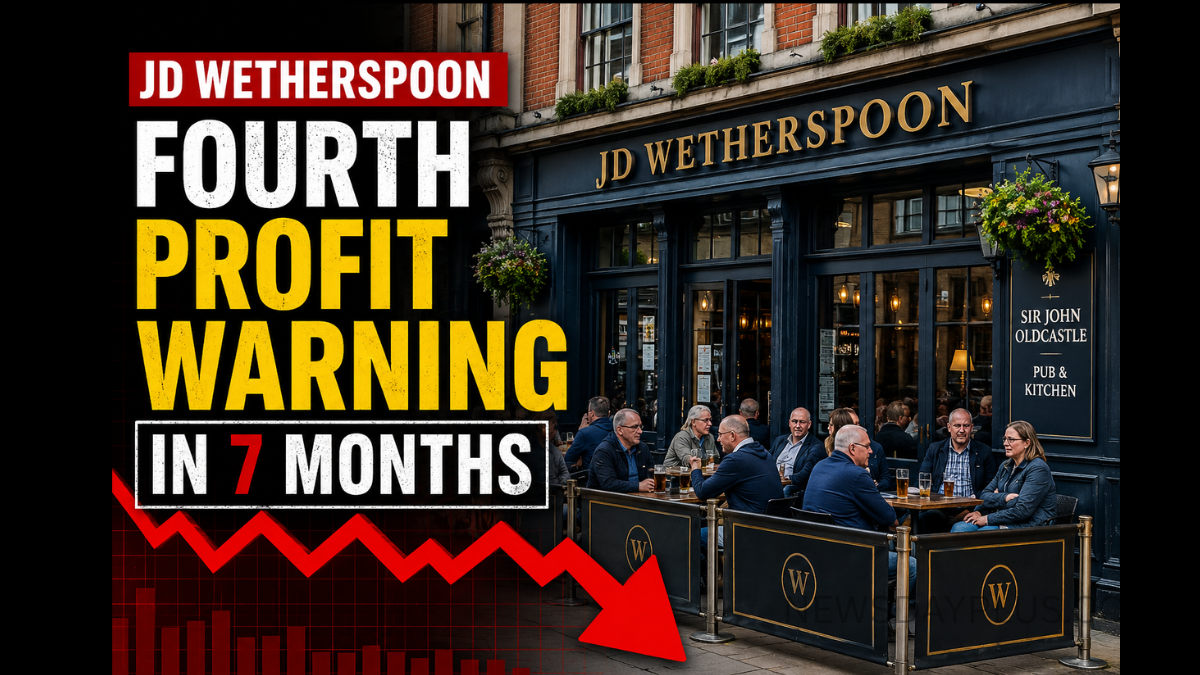
Why JD Wetherspoon issued another profit warning
In its latest trading update, the company said cost pressures have intensified, particularly after changes to employer National Insurance contributions and increases in the National Living Wage.
Key reasons behind the warning
-
Higher employee wages
-
Increased payroll taxes
-
Rising food and drink operating costs
-
Weaker discretionary spending by customers
-
Pressure on profit margins despite higher sales
Wetherspoon said sales have remained positive, but the extra revenue is not enough to fully offset the increase in operating expenses. The Guardian
The scale of the problem
This is now the fourth downgrade to profit expectations since late 2025, an unusually high number for one of Britain’s largest pub operators.
Profit warning tracker
Late 2025
Early 2026
Spring 2026
July 2026
Four warnings within seven months
The repeated warnings suggest that management expects the cost environment to remain difficult through the rest of the financial year, rather than viewing the issue as a short-term setback.
What management said
Founder and chairman Tim Martin has repeatedly criticized the UK government’s tax and wage policies, arguing that they place a heavier burden on hospitality businesses than on supermarkets.
According to the company, pubs face significantly higher employment costs while also dealing with intense price competition from grocery chains selling alcohol at lower margins.
Martin warned that these structural pressures could lead to lower profitability across the pub industry, not just at Wetherspoon. The Guardian
Investor reaction
The market reacted negatively to the announcement, with Wetherspoon shares falling after the update.
|
Area |
Direction |
|---|---|
|
Sales |
Up
|
|
Operating costs |
Up
|
|
Profit expectations |
Down
|
|
Investor sentiment |
Negative
|
Analysts said the update is particularly concerning because revenue growth is continuing. Normally, higher sales help absorb fixed costs, but in this case wage and tax increases are rising faster than the company can improve margins.
What this means for customers
For pub-goers, the warning could eventually translate into:
-
Higher drink prices
-
More expensive food menus
-
Reduced promotional offers
-
Slower expansion of new pub locations
-
Tighter staffing levels during quieter periods
Wetherspoon is known for its value pricing, so management may try to avoid large price increases. However, analysts say some menu inflation is likely if costs continue to rise through 2026.
A warning sign for the wider hospitality sector
The announcement is being viewed as a broader signal for UK hospitality companies.
Many restaurant chains, hotel operators, and pub groups are facing the same combination of:
-
rising wages,
-
higher energy and supply costs,
-
increased taxation,
-
and cautious consumer spending.
Industry groups have warned that smaller independent pubs could be even more vulnerable because they lack the scale and purchasing power of large chains such as Wetherspoon.
Could profits recover?
Wetherspoon’s recovery will likely depend on three factors:
1. Consumer spending improves
If inflation eases and household finances stabilize, customers may return to pubs more frequently.
2. Cost inflation slows
Any moderation in wage growth or payroll taxes would provide immediate relief to margins.
3. Operational efficiency
The company has historically been effective at controlling costs through centralized purchasing and high-volume sales, and further efficiency measures may help offset some of the pressure.
For now, however, management appears to be preparing investors for a more challenging earnings environment over the coming quarters.
The bottom line
JD Wetherspoon’s fourth profit warning in seven months is one of the clearest signs yet that the UK hospitality industry remains under significant financial strain in 2026.
While the company is still attracting customers and growing sales, rising labor costs and taxes are eating into profits faster than revenue can compensate. Investors will now be watching upcoming earnings results closely to see whether this is the final downgrade — or a sign of deeper problems ahead.
For consumers, the immediate impact may be limited, but the era of ultra-cheap pub food and drinks could become harder for operators to sustain if cost pressures remain elevated through the rest of the year.

About the Author
Aparna is the founder and editor of NewsDayPlus, where he covers breaking U.S. news, Social Security updates, finance, stock market trends, technology, consumer affairs, and major national events. He researches information from official government agencies, company announcements, and reputable news sources to produce accurate, fact-checked, and reader-friendly articles. His mission is to make complex topics simple, reliable, and useful for everyday readers across the United States.