
A small electrical connection could leave some Mustang drivers without power, headlights, or other critical functions when they need them most.
The problem starts with a part most drivers will never see.
Ford is recalling 148,663 Mustang vehicles in the United States because wiring connections in the engine compartment may fracture and trigger a loss of drive power or disable critical systems. The Ford Mustang recall affects certain 2024 through 2026 models and raises an unsettling question for owners: What happens when your car suddenly loses power while you’re driving?
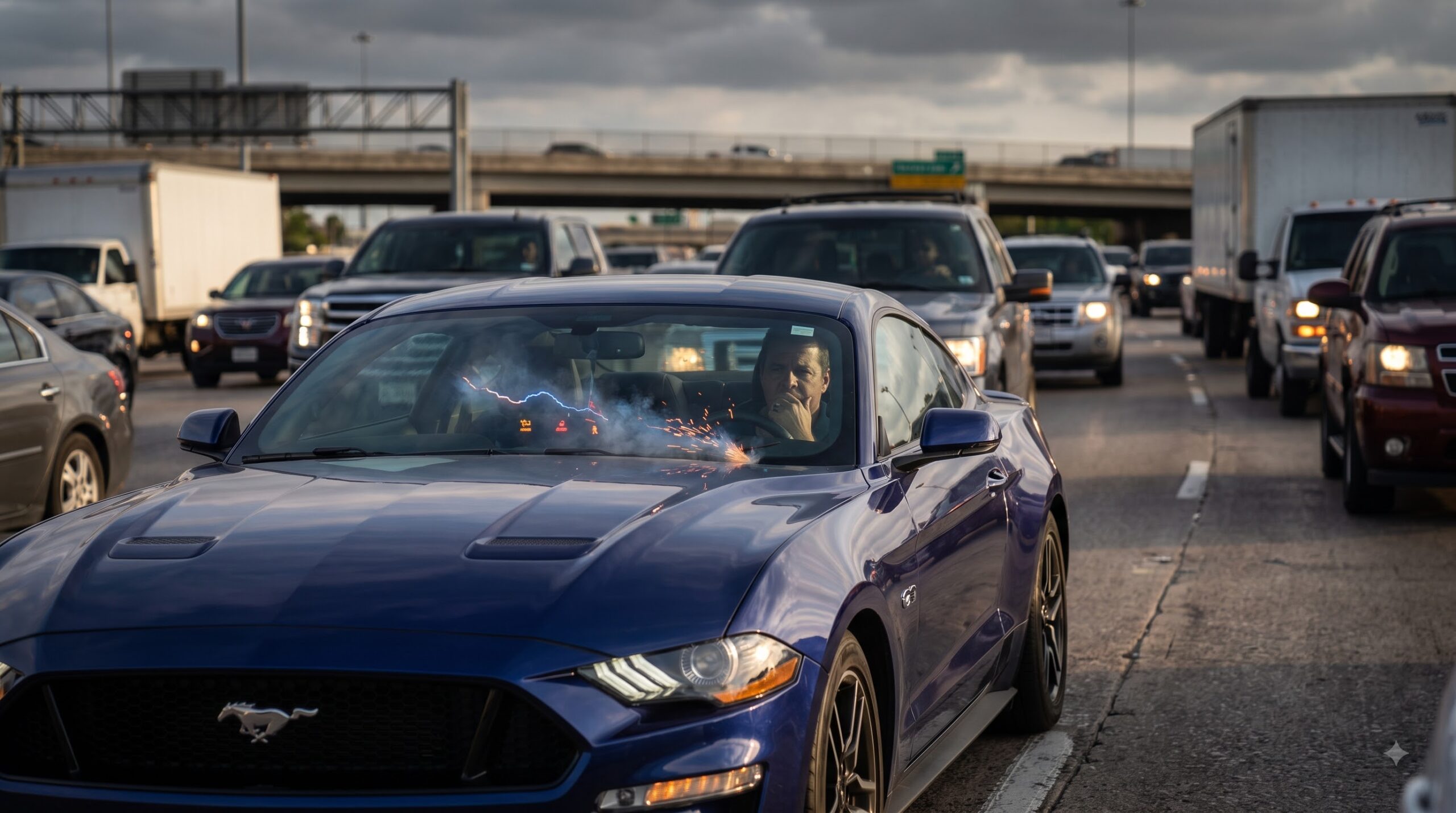
A Tiny Wiring Problem With Potentially Huge Consequences
The defect involves ground connections in the Mustang’s engine-compartment wiring harness.
That may sound like the kind of mechanical detail you’d skip over in an owner’s manual. But those connections help support electrical systems that drivers depend on every day.
According to the recall information, the connections may fracture. If that happens, a Mustang could lose drive power or experience failures involving the headlights, windshield washing system, air conditioning, or engine cooling fan.
The most serious risk is the possibility of losing drive power unexpectedly.
Imagine you’re merging onto a highway, passing a truck, or moving through a busy intersection. Your Mustang doesn’t need to suffer a dramatic crash to create danger. A sudden loss of power alone can put the driver in a difficult and potentially dangerous situation.
That’s why the National Highway Traffic Safety Administration treats the problem as a safety recall.
A loss of drive power can increase the risk of a crash. Losing headlights or windshield washing capability can also reduce visibility, creating another layer of danger when conditions already turn against you.
And here’s the part that may surprise many Mustang owners: one small wiring connection can affect several systems at once.
Think of it like a loose connection behind the wall in your home. One damaged wire might not just turn off a single lamp. It could affect an entire section of the house.
In a modern car, electrical systems work much the same way.
The wiring itself may be hidden from view, but its failure can quickly become impossible to ignore.
Why This Recall Matters to Everyday Drivers
The Ford Mustang isn’t some obscure vehicle that most Americans never see.
It’s one of the country’s most recognizable cars, with a name that has survived generations of changing tastes, fuel prices, and automotive technology. For many owners, a Mustang is more than transportation.
It’s a weekend car.
It’s a first big purchase.
It’s the vehicle someone spent years dreaming about.
That’s what makes a recall involving nearly 150,000 vehicles feel personal.
If you own an affected Mustang, you may now wonder whether your car could lose power without warning. Even if the problem never appears, that uncertainty can change how you think about getting behind the wheel.
Ford’s recall covers certain 2024, 2025, and 2026 Mustang models. The affected population includes vehicles built across a production period stretching from September 2022 into June 2026.
That doesn’t mean every Mustang from those model years has the defect.
Recall eligibility depends on the specific vehicle and its VIN. Owners should check whether their individual Mustang falls under campaign 26V547000 rather than assuming that model year alone determines coverage.
Still, the number is enormous.
148,663 vehicles.
That’s enough Mustangs to fill a massive city parking system many times over.
And every one of those owners now has the same basic concern: Is my car one of them?
The Real Cost Isn’t Always Money
Ford says dealers will replace the affected engine-compartment wiring harness ground terminals at no cost to owners. That matters because safety recalls shouldn’t leave drivers paying to fix a manufacturing-related problem.
But a free repair doesn’t mean the recall costs drivers nothing.
Time has value.
You may need to schedule an appointment, drive to a dealership, arrange transportation, or leave your vehicle behind while the service department completes the work.
For someone with one vehicle, even a short repair visit can become a logistical headache.
Parents still need to get children to school.
Workers still need to get to their jobs.
Families still need groceries.
And if your Mustang is the car you use for a daily commute, the recall suddenly becomes part of your weekly schedule whether you planned for it or not.
That’s the human side of automotive recalls that often disappears behind the numbers.
A company announces that hundreds of thousands of vehicles need repairs, and the story sounds like a corporate statistic.
But each vehicle belongs to someone.
Someone may have purchased that Mustang only months ago.
Someone may be making monthly payments.
Someone may have saved for years to buy it.
Now that owner has another appointment to make and another safety concern to think about.
A recall may begin with a part number, but it ends up on someone’s calendar.
Wait, One Broken Connection Can Affect All That?
Yes—and that’s where modern vehicles become both impressive and complicated.
Today’s cars rely on networks of electrical components that communicate and support multiple functions. A damaged connection can cause problems far beyond one isolated feature.
In the affected Mustangs, the fractured ground connections may contribute to failures involving drive power, headlights, windshield washers, air conditioning, and the engine cooling fan.
That’s the moment that makes many drivers stop and think: Wait, really?
A connection small enough to hide inside an engine compartment can potentially interfere with systems that affect how the vehicle moves, how the driver sees the road, and how the engine manages heat.
Modern cars are engineering marvels.
They’re also deeply interconnected machines.
That creates a strange trade-off.
The technology gives drivers more comfort, more capability, and more features than ever before. But it also means a single weak point can sometimes create consequences across several systems.
The Mustang recall is a reminder that cars aren’t simply engines on wheels anymore.
They’re moving networks of mechanical parts, computers, sensors, and electrical connections.
When everything works, it’s easy to forget how complicated that system really is.
When something fails, you remember immediately.
Ford’s Fix Is Free, but the Full Remedy Takes Time
Ford plans to address the issue by replacing the affected wiring harness ground terminals with revised components.
Owners began receiving interim notifications about the safety risk, while additional communication is expected once the final remedy becomes available. Recall information currently indicates the full remedy is anticipated around March 2027.
That timeline may frustrate some owners.
A recall announcement tells you something needs attention. But knowing that the final repair process may extend months into the future can leave drivers wondering what they should do in the meantime.
The key step is checking your VIN and following Ford’s instructions for your specific vehicle.
Owners can also monitor recall information through NHTSA’s safety recall database, which allows drivers to check whether their vehicle identification number appears in an active campaign.
This is one situation where guessing isn’t helpful.
Your Mustang may fall within the affected production range but still not be included in the recall. Or it may qualify even though you haven’t yet received a letter.
The VIN gives you the clearest answer.
Critics Will Ask Why the Problem Reached So Many Cars
The recall creates an obvious tension between scale and safety.
Ford builds vehicles in enormous numbers, and modern manufacturing requires thousands of components to work correctly across years of production. Supporters of large automakers often point out that recalls can demonstrate a company’s willingness to identify problems and fix them.
Critics see the situation differently.
They’ll ask why a component capable of affecting drive power and several critical systems remained in vehicles long enough to reach nearly 150,000 Mustangs.
Both arguments have weight.
Recalls exist because no manufacturer can realistically guarantee that every component will perform perfectly forever. At the same time, drivers expect companies to catch safety-related defects as quickly as possible.
According to reporting on the recall, Ford began investigating the issue after durability testing identified broken wiring eyelets, and the company later approved the broader recall after reviewing the problem. No accidents or injuries related to this specific defect had been reported in the available recall reporting.
That distinction matters.
The absence of reported injuries doesn’t make the risk imaginary. It means the recall is designed to address the potential danger before a larger pattern of crashes emerges.
That’s exactly what a safety recall is supposed to do.
What Mustang Owners Should Watch for Next
Right now, the biggest thing affected owners should watch is communication from Ford and the availability of the final repair.
The recall campaign is identified as Ford campaign number 26C40 and NHTSA recall number 26V547000. Dealers will replace the affected wiring harness ground terminals free of charge.
If you own a 2024, 2025, or 2026 Mustang, checking your VIN is the smartest next move.
Don’t assume your car is affected simply because it shares the same model year. And don’t assume you’re safe simply because you haven’t received a notice yet.
Recall databases update, mailing schedules take time, and vehicle ownership records can change.
The broader story is also worth watching.
Ford’s Mustang recall arrives during a period when vehicles are becoming increasingly dependent on electrical systems. That means manufacturers face a growing challenge: making cars more advanced without creating more ways for one component failure to disrupt everything around it.
For drivers, the lesson is simpler.
Pay attention to recalls.
They may sound routine until the vehicle in the notice is sitting in your driveway.
The most dangerous problem in a car isn’t always the one you can see—it may be the connection you never knew was there.

About the Author
NewsDayPlus Editorial Team
The NewsDayPlus Editorial Team creates accurate, easy-to-understand content covering cars, motorcycles, electric vehicles, automotive technology, vehicle launches, prices, reviews, and industry news.
Our team researches information from reliable and official sources and aims to keep articles useful and up to date.
We are committed to accuracy, transparency, and reader-focused automotive journalism.
For corrections or editorial questions, please contact the NewsDayPlus team through our Contact Us page.
NewsDayPlus Editorial Team
NewsDayPlus.com