
Tesla’s steering-wheel-free robotaxi is now carrying riders, turning a long-promised future into a very real American experiment.
The strangest thing about the Tesla Cybercab is that the car driving through Austin has no steering wheel for you to grab when things go wrong. It has no accelerator or brake pedals either, and right now that futuristic design is drawing the attention of U.S. safety regulators even as Tesla begins putting the vehicle into its Robotaxi service.
The Future Just Pulled Up at the Curb
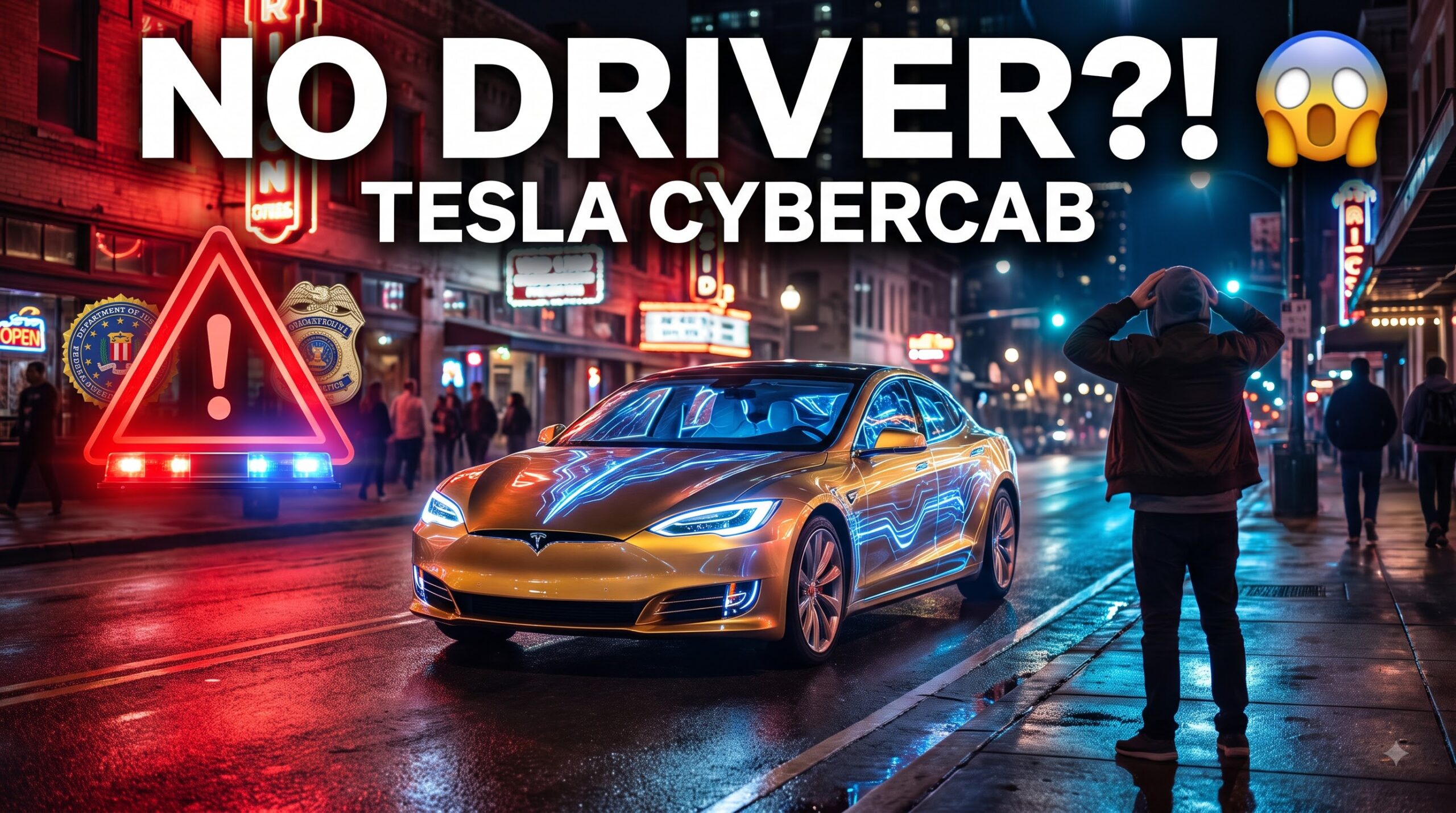
This week, Tesla Cybercab rides are beginning in Austin, Texas, marking one of the biggest real-world tests yet of Elon Musk’s vision for transportation without drivers. The gold-colored, two-seat vehicle uses Tesla’s autonomous technology and is designed from the ground up to operate without traditional human controls.
That means the experience is fundamentally different from sitting in a normal car with advanced driver assistance. You aren’t watching someone else drive. You’re sitting inside a vehicle that is supposed to make every driving decision itself.
For years, autonomous cars have felt like one of those technologies that always seemed five years away. Like the flying cars promised in old movies, the future kept moving further down the road.
Now, at least in parts of Austin, that future is waiting at the curb.
Tesla says its Robotaxi service is expanding across several U.S. cities, while the Cybercab is specifically designed for fully autonomous operation. The vehicle features seating for two passengers, a central touchscreen, butterfly doors, and space for luggage—but no steering wheel or pedals.
That last detail is what makes the Cybercab feel less like an upgraded car and more like a transportation system from another era.
Why the Tesla Cybercab Matters to Ordinary Americans
You don’t have to live in Austin or own a Tesla to understand why this matters.
Transportation is one of the biggest recurring expenses in American life. There are car payments, insurance bills, gasoline, repairs, parking fees, and the constant possibility that something expensive will break at exactly the wrong moment.
The Tesla Cybercab represents a challenge to the basic idea that every American needs to own and operate a vehicle personally.
Imagine your smartphone replacing your camera, GPS, music player, calendar, and alarm clock. Tesla is betting that autonomous transportation could create a similar shift by turning the car itself into something you summon when you need it.
That could eventually change commuting, airport trips, errands, and the late-night drive home.
Tesla’s Robotaxi app allows riders to request autonomous trips, review estimated fares and wait times, and interact with the vehicle through the app. The Cybercab Rider Guide, published this week, lays out how passengers request rides and identify their assigned vehicle.
The convenience is easy to imagine. Your car arrives. You get in. Nobody is behind the wheel because there is no wheel.
And that’s the moment that can make even technology enthusiasts pause.
Wait, really?
For more than a century, Americans have understood one basic rule about cars: if something goes wrong, the person behind the wheel takes control. The Cybercab removes that familiar safety net completely.
For Families, Workers, and Drivers, the Stakes Are Much Bigger
For some Americans, autonomous transportation could create new freedom.
Older adults who can no longer drive safely could gain another way to move around independently. People with certain mobility challenges could have more transportation options, although Tesla currently directs riders needing wheelchair-accessible vehicles to third-party providers rather than offering them directly.
For families, a reliable autonomous ride could eventually mean fewer complicated logistics. A parent might not need to leave work early for every appointment, and someone who doesn’t own a car might gain easier access to jobs or services.
But every technological revolution creates winners and losers.
Professional drivers have obvious reasons to watch closely. Taxi drivers, ride-hailing drivers, delivery workers, and others whose incomes depend on operating vehicles could face a transportation industry that increasingly needs fewer humans behind the wheel.
The money question is just as important.
Tesla has long promoted the idea that autonomous vehicles could dramatically reduce the cost of transportation by eliminating the driver from the business model. Musk previously said the Cybercab could eventually cost less than $30,000, though the vehicle is not currently being broadly sold to ordinary consumers.
Tesla is also signaling that its ambitions may extend beyond simply operating its own robotaxi fleet. The company has asked businesses about interest in buying Cybercab fleets or providing infrastructure, suggesting a potentially much larger network could emerge if the technology and regulations allow it.
That could turn autonomous transportation into something resembling the modern airline industry: you may not own the machine that moves you, but you expect it to arrive safely, reliably, and when you need it.
The difference is that this machine is navigating city traffic on its own.
The biggest question isn’t whether Americans can imagine driverless cars anymore—it’s whether they’ll trust one when the driver’s seat doesn’t exist.
The Safety Debate Is Already Heating Up
Tesla’s timing couldn’t be more dramatic.
The National Highway Traffic Safety Administration is now examining Tesla’s Cybercab rollout and reviewing questions surrounding compliance with federal safety standards. The agency’s interest centers partly on the vehicle’s unusual design, including its lack of traditional manual controls.
Tesla supporters argue that purpose-built autonomous vehicles could ultimately become safer than human-driven cars. Human drivers get tired, distracted, angry, intoxicated, and careless.
A machine doesn’t check a text message while approaching an intersection.
Critics, however, argue that removing the steering wheel raises the stakes enormously when autonomous software encounters something unexpected. Tesla also relies heavily on cameras and AI for the Cybercab, while competitors such as Waymo use combinations of cameras, radar, and lidar.
That’s the central tension.
Tesla believes simpler hardware and increasingly capable AI can solve the driving problem. Skeptics believe the real world is too unpredictable to trust a camera-focused system without additional layers of sensing.
Both sides understand what’s at stake: whoever proves autonomous transportation can scale safely could reshape one of America’s largest industries.
What Happens Next Could Define Tesla’s Future
The next few weeks will matter far more than the launch event itself.
Tesla now has to show that the Cybercab can operate safely beyond carefully managed demonstrations and limited early deployments. Regulators will watch. Competitors will watch. Investors will watch.
And ordinary Americans will watch too.
Tesla already faces a competitive landscape led by Waymo, which operates thousands of autonomous vehicles across multiple U.S. cities, while Tesla’s Cybercab fleet is still in its early stages. The race isn’t simply about building a futuristic vehicle; it’s about proving that a robotaxi network can work at scale, earn public trust, and survive intense regulatory scrutiny.
The Cybercab also arrives at a critical moment for Tesla.
The company is trying to convince investors and consumers that its future isn’t limited to selling electric cars. Robotaxis, artificial intelligence, and autonomous systems could become the next chapter of Tesla’s business.
That makes Austin more than a launch location.
It’s a live test.
If the Cybercab succeeds, Americans may gradually stop thinking of a car as something that must sit in their driveway. Transportation could become more like electricity or internet service—something you call on when needed.
If it fails, the consequences could be equally significant.
A serious safety problem could slow autonomous vehicle development across the industry and strengthen the argument that regulators need tighter controls before driverless cars spread nationwide.
For now, the Tesla Cybercab remains one of the boldest experiments happening on American roads.
The future of driving may have arrived—but the biggest surprise is that nobody’s driving it.

About the Author
NewsDayPlus Editorial Team
The NewsDayPlus Editorial Team creates accurate, easy-to-understand content covering cars, motorcycles, electric vehicles, automotive technology, vehicle launches, prices, reviews, and industry news.
Our team researches information from reliable and official sources and aims to keep articles useful and up to date.
We are committed to accuracy, transparency, and reader-focused automotive journalism.
For corrections or editorial questions, please contact the NewsDayPlus team through our Contact Us page.
NewsDayPlus Editorial Team
NewsDayPlus.com