
The 2027 Social Security COLA is estimated at 3.7%–3.8%, a jump from this year’s 2.8%. Here’s what that means for your monthly check and the program’s future.
2. EXECUTIVE NEWS SUMMARY
Current estimates from the Senior Citizens League and independent analyst Mary Johnson place the 2027 Social Security cost-of-living adjustment between 3.7% and 3.8%, up from the 2.8% increase that took effect in January 2026. The projected raise would add roughly $74 to average monthly checks but could accelerate the program’s trust fund insolvency timeline. The official figure won’t be confirmed until October 2026.
3. FEATURED SNIPPET ANSWER
The 2027 Social Security COLA is currently projected at 3.7% to 3.8%, based on Consumer Price Index data through June 2026. A 3.8% adjustment would raise the average monthly Social Security benefit by approximately $74, from roughly $1,938 to $2,011. The Social Security Administration will announce the official figure in October 2026, using CPI-W data from July through September.
4. MAIN ARTICLE
2027 Social Security COLA Projected Between 3.7% and 3.8% — But a Bigger Check Comes With a Cost
More than 75 million Americans who rely on Social Security and Supplemental Security Income could see their monthly benefits rise by close to 4% in January 2027, according to the latest projections from senior advocacy groups and independent analysts.
The projected increase would be the largest cost-of-living adjustment since 2023. But it arrives alongside a stark warning: a higher payout accelerates the program’s march toward insolvency.
What Happened?
New estimates show Social Security’s annual cost-of-living adjustment for 2027 may fall between 3.7% and 3.8%, based on government inflation data released in mid-July showing that prices cooled in June as energy costs declined. AARP
The Senior Citizens League (TSCL), a nonpartisan senior advocacy group, predicts the 2027 COLA will reach 3.8% — one full percentage point above the 2.8% adjustment that took effect at the start of 2026. 401(k) Specialist
Independent Social Security and Medicare analyst Mary Johnson places her estimate slightly lower, at 3.7% — a figure that dropped a full percentage point from her prior month’s projection of 4.7% following the June inflation data. AARP
The cooling inflation numbers brought both estimates down from earlier in the year. But both analysts and advocacy groups still expect 2027’s adjustment to outpace the last two years.
Background & Context
Social Security’s annual COLA is not discretionary. Congress codified automatic inflation adjustments in 1972, and the system has run on that schedule since 1975.
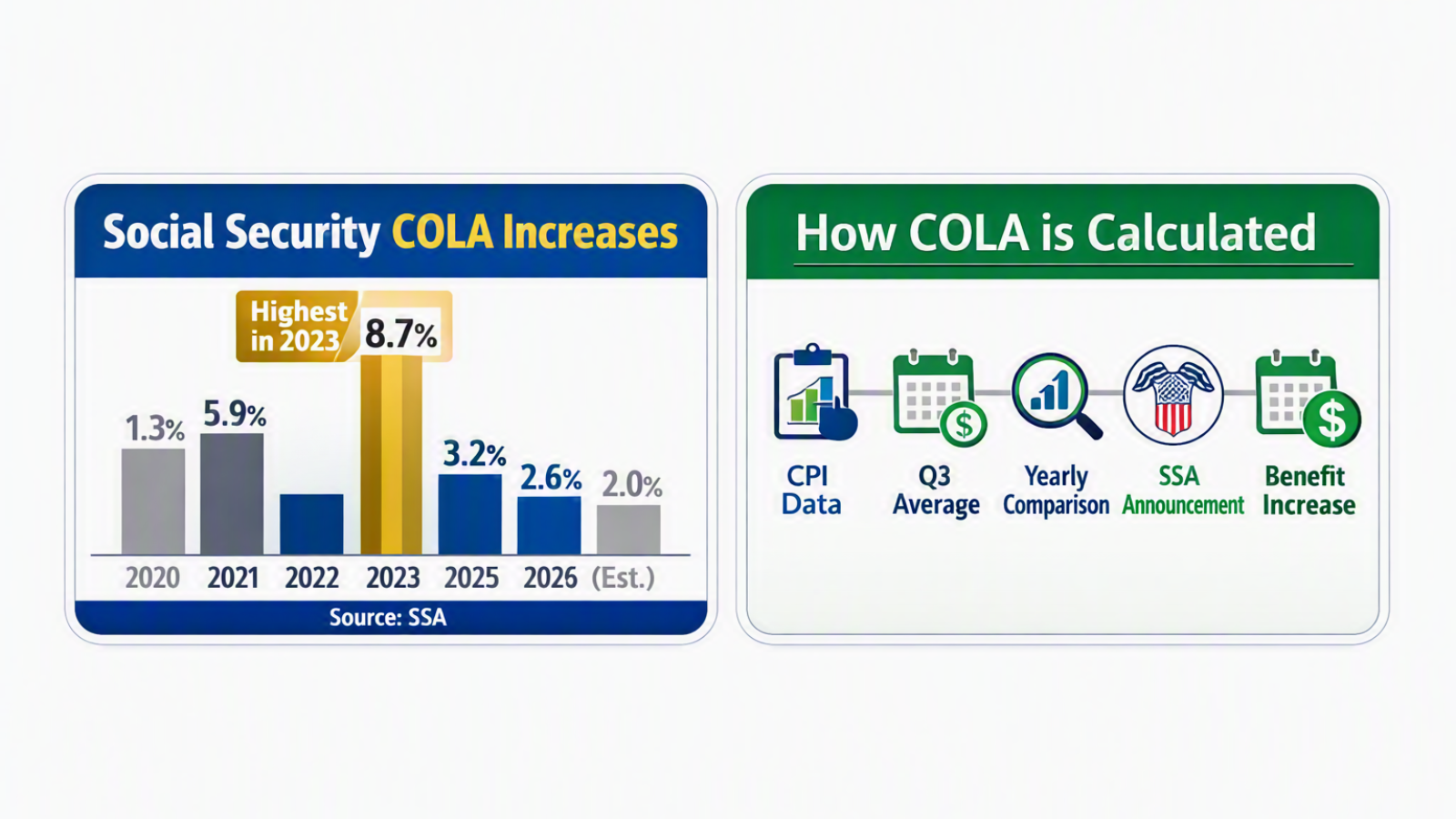
The Social Security Administration calculates each year’s COLA by comparing the average Consumer Price Index for Urban Wage Earners and Clerical Workers — known as the CPI-W — during the third quarter of the current year against the same three-month period from the prior year. The percentage difference between the two figures becomes the official COLA, applied to checks beginning in January of the following year. The Senior Citizens League
The 2026 COLA, which took effect in January, was 2.8%. It increased the average monthly benefit for a retired worker by about $56, from $2,015 to $2,071, according to Social Security Administration estimates. Fox Business
The largest COLA on record came in 1980, when inflation pushed the adjustment to 14.3%. From 2001 through 2025, the average annual COLA ran about 2.6%. Fox Business
By that measure, a 3.8% adjustment in 2027 would rank well above the long-run average.
Official Statements & Reaction
TSCL Executive Director Shannon Benton framed the moment as both a financial opportunity and a warning: “Right now, we have a golden opportunity to act. The 2026 Social Security Trustees Report projects that the program’s trust fund will reach insolvency in Q4 2032, forcing an automatic benefits cut. Congress will almost certainly have to pass a bill to address the program’s finances in the next few years.” U.S. News & World Report
Independent analyst Mary Johnson acknowledged the significance of the inflation drop: “This is a significant drop in inflation, and one that we’ve rarely seen in the June CPI data over the past five years. There was only one other time when inflation dropped in the month of June, and not by this amount.” Fox Business
Johnson added that ongoing tensions in the Middle East affecting oil prices make it unclear whether the drop will hold through the summer.
TSCL Executive Director Shannon Benton also addressed the purchasing-power gap many retirees are experiencing: “We’re seeing inflation on the rise when more than half of seniors already can’t afford basic living standards. We’re talking about food, a roof over their head, and transportation.” PSCA
Expert Analysis & Economic/Social Impact
The COLA’s mechanics create a timing problem for millions of retirees.
The adjustment is backward-looking. Because the 2027 adjustment will be based on inflation from July through September, seniors may lose ground if prices rise sharply before or after that measurement window. fool
Seniors received a 2026 COLA of 2.8%, but the Consumer Price Index rose at an annual rate of 3.8% in April and 3.3% in March, meaning millions of Social Security recipients fell behind surging consumer prices throughout much of the year. fool
There is also a fiscal tension embedded in a larger COLA. The nonpartisan Committee for a Responsible Federal Budget estimated in May that a 3.8% COLA for 2027 would worsen Social Security’s fiscal shortfall by about $300 billion over the next decade and advance the insolvency of a key trust fund by three months from late 2032. The Senior Citizens League
For retirees, the raise is necessary. For the program’s long-term finances, every dollar paid out draws down reserves that Congress has not yet found a way to replenish.
Opposing Views & Key Debates
Supporters of a higher COLA argue the adjustment is simply doing what the law intends — protecting retirees’ purchasing power against inflation. Advocacy groups including TSCL point out that even a 3.8% adjustment may not fully compensate seniors for the real-world cost increases they face, particularly in housing and healthcare.
TSCL and other advocacy groups have argued for years that the CPI-W is the wrong measuring stick. They contend the CPI-W’s market basket reflects the spending patterns of younger urban wage earners — giving heavier weight to gasoline and electronics — rather than the healthcare, housing, and prescription drug costs that dominate retiree budgets. Fox Business
Congress reintroduced the Social Security 2100 Act, which would switch the COLA calculation to the CPI for the Elderly (CPI-E). The bill would also raise the minimum benefit to 125% of the federal poverty line and expand the payroll tax to income above $400,000. If passed, TSCL says the legislation would extend Social Security’s solvency by an additional 32 years — though passage remains unlikely. U.S. News & World Report
Fiscal hawks and budget analysts counter that raising COLAs without addressing the underlying funding gap accelerates the timeline to automatic benefit cuts. The CRFB has consistently warned that without legislative action, the program’s insolvency will trigger cuts for all beneficiaries — including those who can least afford it.
Who Is Affected?
Current Social Security retirees are the most direct beneficiaries. A 3.8% COLA would raise the average Social Security check by about $74, from an estimated $1,938 to approximately $2,011 per month, according to TSCL’s latest projection. Napa Net
Supplemental Security Income (SSI) recipients, who include low-income disabled and elderly individuals, receive the same annual COLA adjustment and would see proportional increases to their monthly payments.
Near-retirees approaching benefit-claiming age face a different calculation. Rising COLAs increase their projected monthly payments, but accelerated trust fund depletion raises the risk of future cuts if Congress does not act before 2032.
Working Americans and payroll tax payers ultimately fund the system. Any expansion of the program’s obligations without a corresponding revenue fix shifts more fiscal pressure onto the existing tax base.
Medicare Part B enrollees face a parallel cost pressure. Standard premiums for Medicare Part B in 2027 are set to rise from $202.90 per month in 2026, an increase of $6.60, or 3.3%. For many retirees, a portion of any COLA increase will be absorbed by higher Medicare premiums deducted directly from Social Security checks. AARP
Key Data & Statistics
| Metric | Figure |
| Projected 2027 COLA (TSCL) | 3.8% |
| Projected 2027 COLA (Mary Johnson) | 3.7% |
| Projected 2027 COLA (AARP) | 3.6% |
| 2026 COLA (official) | 2.8% |
| 2025 COLA | 2.5% |
| Estimated average monthly benefit (current) | ~$1,938 |
| Estimated average monthly benefit (at 3.8% COLA) | ~$2,011 |
| Estimated monthly dollar increase | ~$74 |
| CPI-W year-over-year (June 2026) | 3.5% |
| Social Security trust fund projected insolvency | Q4 2032 |
| 10-year fiscal impact of 3.8% COLA (CRFB estimate) | ~$300 billion added to shortfall |
| Trust fund insolvency acceleration (at 3.8% COLA) | ~3 months earlier |
| Total Social Security/SSI beneficiaries | 75 million+ |
| Medicare Part B premium increase (2027) | +$6.60/month |
What Happens Next?
The official 2027 COLA will not be set until mid-October 2026.
By law, the annual Social Security COLA is calculated using Bureau of Labor Statistics CPI inflation data for the months of July, August, and September. The announcement of the final COLA amount typically occurs in mid-October when the agency releases September inflation data. The Senior Citizens League
Between now and that announcement, the July and August CPI-W reports — due in August and September — will significantly shape the final number. Energy prices, which dropped sharply in June following a brief Middle East ceasefire, have since bounced higher as the conflict resumed. Sustained energy price increases through the summer could push the COLA estimate back above current projections.
Congress faces a separate but related deadline. The 2026 Social Security Trustees Report projects trust fund insolvency in Q4 2032. Absent legislative action before then, current law would trigger automatic benefit cuts affecting all recipients — regardless of what any individual COLA adjustment has been in the intervening years. AOL
The Social Security 2100 Act, recently reintroduced in Congress, remains a long shot. The bill was first introduced in 2017 and has not passed in any of its previous iterations.

About the Author
Aparna is the founder and editor of NewsDayPlus, where he covers breaking U.S. news, Social Security updates, finance, stock market trends, technology, consumer affairs, and major national events. He researches information from official government agencies, company announcements, and reputable news sources to produce accurate, fact-checked, and reader-friendly articles. His mission is to make complex topics simple, reliable, and useful for everyday readers across the United States.