
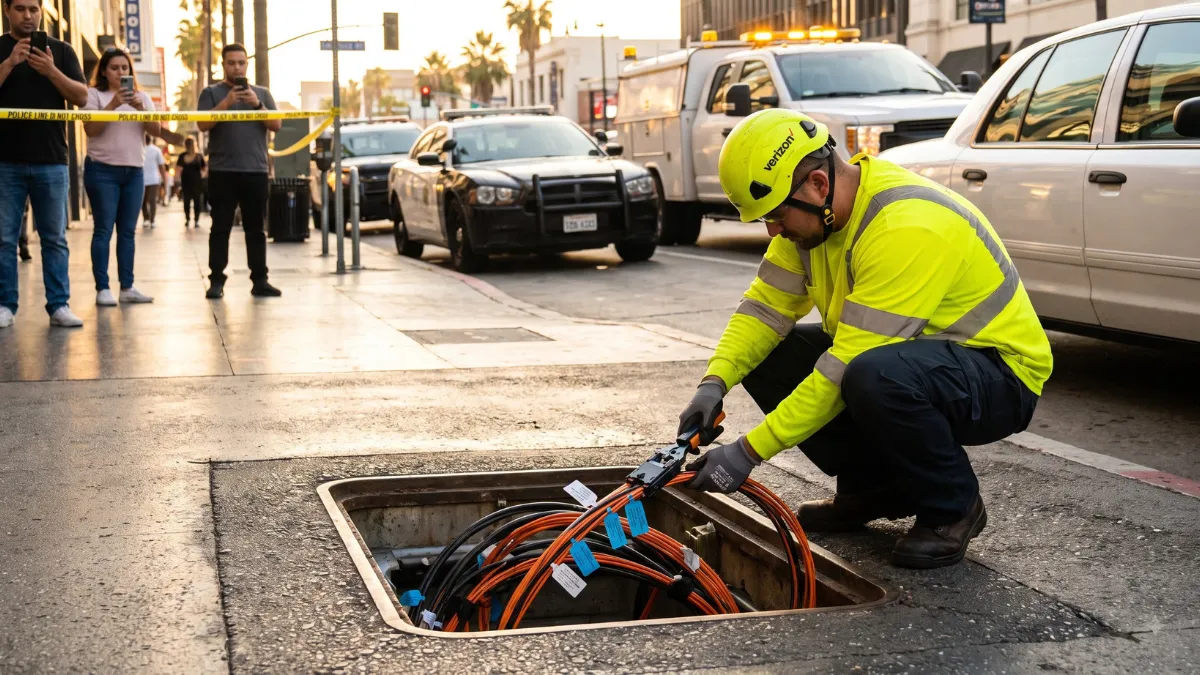
Vandals Cut Verizon’s Fiber Cables and Silenced Los Angeles Sunday
A deliberate act of sabotage knocked out Verizon service across Southern California, leaving thousands without calls, texts, or internet.
Someone grabbed a cutting tool and took down a piece of Los Angeles. More than 12,000 Verizon users reported outage and cell signal issues Sunday afternoon, according to Downdetector — and this wasn’t a server crash or a software bug. Vandals cut multiple fiber cables, and the Verizon outage in Los Angeles spread fast, hitting mobility and internet customers across Southern California within hours.
What Actually Happened Sunday
Verizon customers across Southern California lost service after multiple fiber lines were vandalized. The company confirmed the cause but didn’t say exactly where the cuts happened or name a suspect. Outage reports peaked at over 13,000 complaints on Downdetector, with Los Angeles among the hardest-hit cities alongside New York and Boston.
Here’s the part that should genuinely unsettle you. A fiber-optic cable is basically the spinal cord of a modern city’s communications. It doesn’t matter if you’re carrying the latest iPhone or paying for the most expensive unlimited plan on the market — if someone severs that cable, your phone becomes a very sleek, very expensive paperweight. One person, one act, and 12,000 people go dark simultaneously.
Repairs started Sunday afternoon, and Verizon expected service to return by early evening. Engineers worked alongside third-party vendors at the damaged sites. Verizon told customers to monitor its Check Network Status page for updates specific to their area.
Why This Hits Different Than a Normal Outage
Most Verizon outages trace back to equipment failures or software glitches — annoying, but fixable from a control room. This one required humans to physically drive to the damage, locate the cuts, and repair infrastructure buried under or strung across one of the most congested metro areas in America. That takes time. And while technicians scramble, you’re offline.
Verizon didn’t hold back in its response. “Acts of network theft and vandalism represent a direct threat to the safety and security of our communities,” a company spokesperson said. “These are not simple property crimes — they are dangerous disruptions that cut off vital lifelines for our first responders and public safety officials who rely on constant connectivity.” That’s not corporate boilerplate. That’s a warning.
Real People, Real Consequences
Picture a Sunday afternoon in Los Angeles. Someone’s trying to navigate home from an unfamiliar part of the city — no GPS. A parent texts their college-age kid to check in — no delivery. A food delivery driver refreshes the app waiting for the next order — nothing loads. These aren’t edge cases. These are the ordinary rhythms of modern life, and they all collapsed at once for thousands of people this week.
Small business owners feel this in their wallets. Mobile point-of-sale systems, digital invoices, contactless payments — they all run through the same cell network that went down Sunday. If your Sunday afternoon revenue depends on Verizon and Verizon goes dark, you don’t get those hours back. There’s no refund for a shift that couldn’t process a single transaction.
The Debate No One Wants to Have
Critics ask a sharp, fair question: why does critical telecom infrastructure remain this exposed? Miles of fiber run above ground, through utility corridors, and along roadways across Southern California. Protecting all of it is genuinely difficult — but the fact that one targeted act can silence tens of thousands of people raises real questions about redundancy and physical security. Telecom companies build digital redundancy into their systems constantly. Physical redundancy is a harder, more expensive problem, and it shows.
Verizon’s defenders make a reasonable counter-argument. You simply can’t station a guard at every junction box in a metro area stretching from Los Angeles to the Mexican border. The company responded quickly, communicated clearly, and got engineers on-site fast. That matters. But “we responded well” and “our infrastructure is adequately protected” are two very different claims — and only one of them holds up after Sunday.
What You Should Watch For Next
Keep your eyes on two things in the coming weeks. First, watch for any law enforcement announcement about arrests or suspects connected to the fiber cuts. Prosecutors in California treat infrastructure sabotage seriously, and if someone’s identified, charges could come fast. Second, watch for any regulatory response from Sacramento or Washington — this incident is exactly the kind of event that moves telecom security from a policy backburner item to a legislative priority.
Verizon’s own outage map shows repair timelines ranging from four to six hours depending on technician access and damage scope. For future outages — because there will be future outages — that’s the window you’re working with. Set up Wi-Fi calling on your phone now, before the next disruption hits. It routes your calls through your home internet connection and bypasses cellular outages entirely. It’s a thirty-second setup that buys you a lifeline when the network goes down.
Frequently Asked Questions
Q: What caused the Verizon outage in Los Angeles this week? Verizon confirmed that vandals deliberately cut multiple fiber-optic cables across Southern California on Sunday, August 10, 2026. The cuts disrupted wireless and internet service for thousands of customers in Los Angeles and the surrounding region. The company did not publicly name suspects or identify the exact locations of the damage.
Q: How many Verizon customers lost service during the Southern California outage? Downdetector recorded more than 12,000 outage reports at the peak of Sunday’s disruption, with Los Angeles among the most affected areas. The actual number of impacted customers is almost certainly higher — most people don’t file formal outage reports when their service drops.
Q: Did Verizon restore service after the fiber vandalism in Los Angeles? Yes. Verizon deployed engineers and third-party repair crews to the affected sites Sunday afternoon, with service expected to return by early Sunday evening. Customers can visit Verizon’s Check Network Status page at verizon.com/support/check-network-status to check real-time service status in their specific zip code.
Q: Why does cutting a fiber cable knock out so many people at once? Fiber-optic cables carry massive amounts of data and voice traffic simultaneously through a single line. Think of it like a highway — if someone closes the main road, every car that relied on it stops moving, no matter what kind of vehicle it is. A single fiber cut in the right location can cascade into a regional service blackout affecting thousands of customers instantly.
Q: What can Verizon customers do during an outage like this? Restart your device first — it’s the most reliable quick fix for service disruptions. If your signal doesn’t return, switch on Wi-Fi calling through your phone’s settings so you can make and receive calls over a home or business internet connection. Check Verizon’s network status page for updates, and follow local news for any developments if the outage traces back to criminal activity.
When one pair of hands can silence an entire city’s phones, “connectivity” stops being a tech buzzword and starts being something fragile and worth protecting.

About the Author
Aparna is the founder and editor of NewsDayPlus, where he covers breaking U.S. news, Social Security updates, finance, stock market trends, technology, consumer affairs, and major national events. He researches information from official government agencies, company announcements, and reputable news sources to produce accurate, fact-checked, and reader-friendly articles. His mission is to make complex topics simple, reliable, and useful for everyday readers across the United States.