
Tesla and SpaceX’s “Terafab” is officially happening — and it’s bigger than anything Silicon Valley has ever attempted.
A factory that doesn’t just build chips — it builds the infrastructure of tomorrow. That’s what Elon Musk is promising with Terafab, a massive semiconductor manufacturing facility jointly announced by Tesla and SpaceX this week that’s sending shockwaves through the tech industry. Construction is starting within months, and the ambitions behind it are almost hard to wrap your head around.
Here’s what makes this genuinely different from every other “big announcement” you’ve scrolled past this year: this isn’t a startup with a deck and a dream. This is Tesla — the company that already manufactures some of the world’s most advanced electric vehicles — teaming up with SpaceX, the company that literally launches rockets into orbit. Together, they’re building a chip factory unlike anything that currently exists in the United States.
The official announcement dropped on August 6, 2026, and the tech world is still catching its breath. Terafab isn’t just another semiconductor plant — it’s a vertically integrated AI chip manufacturing operation designed to cut America’s dependence on foreign chip suppliers while feeding the insatiable appetite of Musk’s own AI ventures. In plain English? It’s a factory built to make the brains that power the future, right here on American soil.
Think of it this way: for the last two decades, the U.S. has been buying its most critical technology ingredients — chips — from overseas, primarily from Taiwan. It’s a bit like if America grew all its wheat but then sent it to another country to be turned into bread, bought it back at a premium, and then crossed its fingers hoping the supply chain never snapped. Terafab is Musk’s attempt to build the bakery himself.
And the timing couldn’t be more charged. Geopolitical tensions around Taiwan have been simmering for years, and the chip shortage of the early 2020s exposed just how fragile America’s tech supply chain really is. Washington has been throwing money at domestic chip production through the CHIPS Act — but Terafab represents something different. It’s private capital, private ambition, and private urgency moving faster than any government program typically can. This isn’t Washington catching up. This is Musk sprinting ahead.
If you’re wondering what this actually means for your life — not in a vague, abstract way, but in a real way — start with jobs. A facility of this scale doesn’t open without creating thousands of positions across engineering, manufacturing, logistics, and operations. The communities near Terafab’s construction site are about to experience a hiring boom that ripples outward: new housing demand, new restaurants, new schools filling up, new tax bases expanding. This is the kind of industrial moment that genuinely transforms a region, the way auto plants transformed Detroit or aerospace transformed Seattle.
Then there’s the money angle — and it affects you even if you never set foot near a chip factory. Your phone, your car, your thermostat, your doctor’s diagnostic equipment — all of it runs on chips. When those chips are cheaper to produce domestically and more reliably available, the cost eventually works its way down. Not overnight, and not without friction, but the long-term pressure on consumer electronics prices moves in a direction that benefits everyday Americans. More supply, sourced closer to home, means less vulnerability to the kind of shortages that once made you wait eight months for a new gaming console.
What’s genuinely awe-inspiring here — and stop for a second, because this part is wild — is that the chips Terafab is designed to produce aren’t just for your next iPhone upgrade. They’re being engineered to power the next generation of AI systems, autonomous vehicles, and potentially even the onboard computers for SpaceX’s future spacecraft. This one factory sits at the intersection of artificial intelligence, electric transportation, and space exploration simultaneously. There isn’t another facility on the planet that can claim that trifecta.
Not everyone is celebrating, though. Critics are raising questions that deserve to be taken seriously. Some semiconductor analysts point out that building a world-class chip fab from scratch is extraordinarily complex — it took TSMC decades to reach its current level of precision, and the machinery involved requires tolerances measured in nanometers. Skeptics worry that Musk’s track record of ambitious timelines — “construction starting within months” has a familiar ring to anyone who followed early Tesla production promises — might not align with the brutal engineering reality of chip manufacturing.
There’s also a consolidation concern. When one person controls the rockets that launch satellites, the cars that drive autonomously, the AI systems that process data, and the chips that power all of it, that’s a level of vertical integration that makes antitrust experts visibly uncomfortable. Supporters counter that American technological sovereignty is worth the trade-offs, and that a domestic chip champion is exactly what the country needs. Both sides are making arguments worth hearing.
What you should be watching for in the coming weeks and months is straightforward: the location announcement. Where Terafab gets built matters enormously — for jobs, for politics, and for logistics. Several states are almost certainly already in quiet conversations with Musk’s teams, dangling tax incentives and infrastructure commitments. The second thing to watch is the talent pipeline. A factory is only as good as the engineers who run it, and the competition for semiconductor expertise is already fierce globally. How Terafab plans to staff up will tell you a lot about whether this is a genuine industrial operation or an extremely expensive press release.
Watch for the first formal partnership announcements, too. Chip factories need customers locked in before the first wall goes up — and if major tech companies start publicly committing to buying Terafab’s output, that’s when you’ll know this is real in a way that goes beyond the announcement cycle.
America hasn’t built something like this since the space race — and this time, the private sector isn’t waiting for the government to start the countdown.
FAQ
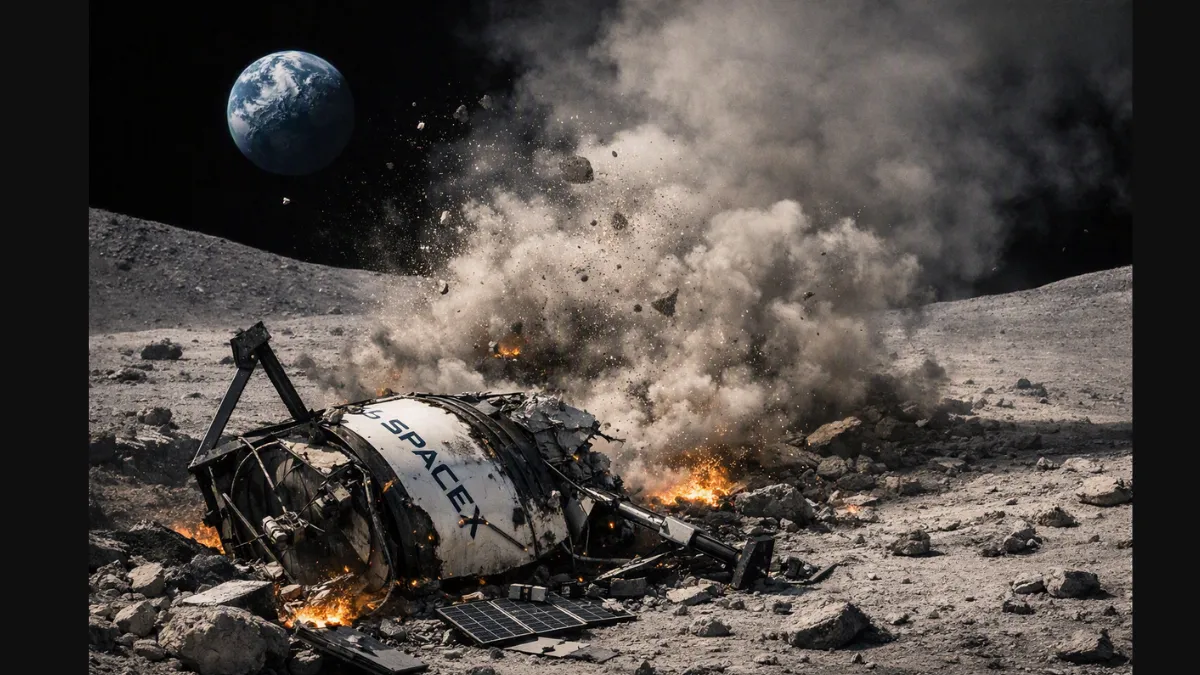
Q1: Did the SpaceX rocket crash on the moon this week?
Yes, reports confirm a SpaceX rocket impacted the lunar surface during a mission.
Q2: Was anyone on board the rocket?
No, the rocket was unmanned and carrying payload equipment.
Q3: Why does a rocket crash on the moon matter to Americans?
It affects aerospace jobs, future satellite technology, and the pace of space innovation.
Q4: What will SpaceX do after this crash?
The company is expected to investigate the failure and adjust future missions.
Q5: Is space travel still safe after this incident?
Space travel remains risky, and this crash highlights the challenges of lunar exploration.

About the Author
Aparna is the founder and editor of NewsDayPlus, where he covers breaking U.S. news, Social Security updates, finance, stock market trends, technology, consumer affairs, and major national events. He researches information from official government agencies, company announcements, and reputable news sources to produce accurate, fact-checked, and reader-friendly articles. His mission is to make complex topics simple, reliable, and useful for everyday readers across the United States.