
Elon Musk has never been known for thinking small. But even by his standards, Terafab is a moonshot.
On Thursday, Tesla and SpaceX confirmed what had been rumored for months: their joint semiconductor factory — dubbed Terafab — will be built in Grimes County, Texas, just outside Houston. The two companies are committing an initial $16.8 billion to get it off the ground, with future expansion phases expected to push that number significantly higher.
“Terafab Texas will be the largest and most valuable building on Earth by far,” Musk wrote on X Thursday morning. “And it will be stunningly beautiful.”
That’s a bold claim. But then again, so was building rockets that land themselves — and SpaceX pulled that off, too.
What Exactly Is Terafab?
At its core, Terafab is a bet that the global chip industry simply cannot keep up with the future Musk is building toward.
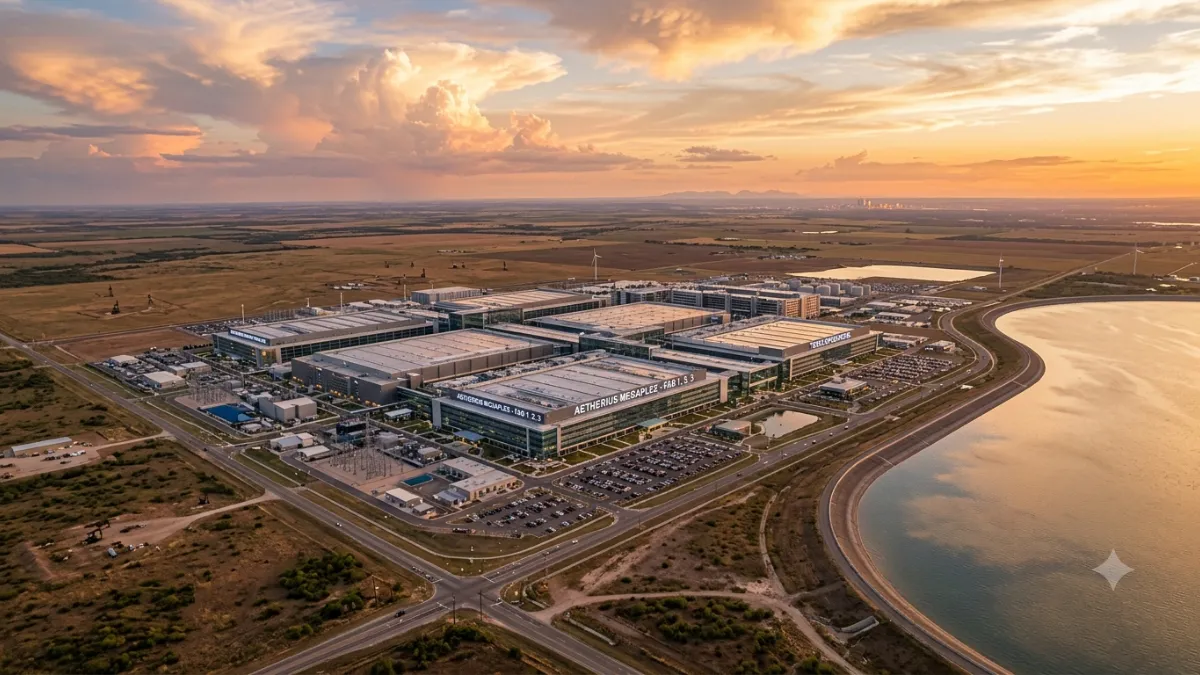
The facility, planned at over 100 million square feet, will manufacture, package, and test advanced logic and memory chips under a single roof — a level of vertical integration the semiconductor industry has never seen at this scale. The chips it produces will power two of Tesla’s most ambitious programs: the Cybercab robotaxi and the Optimus humanoid robot. They’ll also feed SpaceX’s planned network of space-based AI data centers.
Combined, SpaceX and Tesla say their chip demand is expected to exceed one terawatt of computing power annually. For context, the entire global semiconductor industry currently produces roughly 20 gigawatts. That’s not a gap — it’s a canyon.
“The Terafab is bringing cutting-edge manufacturing to America, creating thousands of high-paying jobs in the Lone Star State, and enabling us to produce AI chips at scale for use on Earth and in space,” Musk said in a statement Thursday.
Why Texas — And Why Now?
The site selection wasn’t accidental. SpaceX chose the Gibbons Creek Reservoir in Grimes County — the former home of a steam electric station — for its substantial rainwater storage capacity and its proximity to Houston’s deep labor market. More than 15.9 million people live within a three-hour radius of the site.
The company has already purchased the Navasota River pumping station to manage stormwater, and rather than rely on the state’s ERCOT grid, SpaceX plans to power the facility with its own natural gas plants — a level of infrastructure self-sufficiency that mirrors Musk’s broader philosophy of controlling every variable in his supply chain.
The project will create at least 3,000 jobs, most of them local hires from Grimes and neighboring Brazos County. SpaceX has agreed to pay the county a fixed $20 million per year for 35 years — a total of $710 million — as part of a tax abatement deal.
Construction is expected to begin within months. Renderings are due within days.
The Chip Problem That Started It All
To understand why Musk is building Terafab, you have to understand the supply chain problem he keeps warning about.
At Tesla’s Q4 2025 earnings call, Musk laid it out plainly: external chip suppliers — TSMC, Samsung, Micron — are approaching a ceiling. Their pace of expansion, Musk argued, is far slower than what his companies require.
“There’s a maximum rate at which they’re comfortable expanding,” Musk said at the time. “That rate is much less than we would like… and we need the chips, so we’re going to build the Terafab.”
His math is stark: all current chip fabrication facilities on Earth, combined, produce what he estimates is roughly 2% of what his projects will eventually require. Whether or not that number holds up to scrutiny, the directional argument is hard to dismiss — Tesla’s Optimus robot alone, if produced at the millions-of-units scale Musk envisions, would require a volume of custom AI silicon that no single external supplier can currently promise.
The solution, in classic Musk fashion, is to build it yourself.
Intel Is In. The Rest Is Still Being Written.
Terafab won’t be a solo act. Intel joined the project as a manufacturing partner in April, and the factory is expected to use Intel’s 14A fabrication process — one of the most advanced nodes in the industry — targeting one million wafer starts per month at full capacity.
That partnership adds credibility. Intel has decades of fab experience and a vested interest in rebuilding American semiconductor dominance. For the struggling chipmaker, Terafab represents a lifeline — a guaranteed customer base and a chance to prove its advanced manufacturing chops.
The Skeptics Have a Point, Too
Not everyone is buying the vision at face value.
SpaceX’s own S-1 filing — submitted ahead of the company’s blockbuster IPO in June — includes a pointed disclaimer: Terafab “may not be successful” in closing the chip gap it was designed to solve. The prospectus warns that none of the project’s key collaborations currently have binding terms.
Critics have noted that Musk has no background in semiconductor manufacturing, one of the most technically demanding industries in the world. Building a 2nm-class chip fab from scratch — even with Intel’s help — is an entirely different challenge than building cars or rockets.
There’s also a timing question. The robotaxi market is moving fast. Waymo and Zoox are already operating commercial services in multiple U.S. cities. If competitors lock up market share in the next two years, a chip factory that won’t reach full production for five or more years may arrive too late to matter for Tesla’s autonomous vehicle ambitions.
The Bigger Picture: AI Chips, Space, and a Self-Sufficient Empire
Zoom out, and Terafab is about more than chips. It’s about Musk’s long-running effort to make his constellation of companies — Tesla, SpaceX, and xAI — as self-sufficient as possible.
SpaceX spent $329 million on Tesla’s Megapack battery storage systems in just the first half of 2026, using them to stabilize power supply at its AI data centers. xAI, now a wholly owned subsidiary of SpaceX following a February 2026 acquisition, purchased more than $506 million in Megapacks from Tesla throughout 2025 alone.
The financial flows between these companies tell a story: Musk is quietly knitting together an integrated empire where the output of one company feeds the next, reducing external dependencies at every turn.
Terafab is the next logical piece of that puzzle.
What Comes Next
Groundbreaking is expected within months. Musk has promised that Terafab will produce two categories of chips: inference chips for Tesla vehicles, Cybercabs, and Optimus robots; and D3 high-power chips designed for SpaceX’s orbital data center satellites — a network the company has asked the FCC to license for up to one million satellites.
If it all comes together, Terafab could be the factory that makes Musk’s vision of a robot-filled, self-driving, space-computing future actually viable. If it doesn’t, it will be the most expensive lesson in industrial ambition since the dot-com era.
Either way, America’s chip map just got a very big new pin.
This is an original article based on publicly available reporting and company statements. All facts sourced from public filings, press releases, and news coverage as of August 7, 2026.

About the Author
Aparna is the founder and editor of NewsDayPlus, where he covers breaking U.S. news, Social Security updates, finance, stock market trends, technology, consumer affairs, and major national events. He researches information from official government agencies, company announcements, and reputable news sources to produce accurate, fact-checked, and reader-friendly articles. His mission is to make complex topics simple, reliable, and useful for everyday readers across the United States.