
SpaceX Rocket Moon Crash
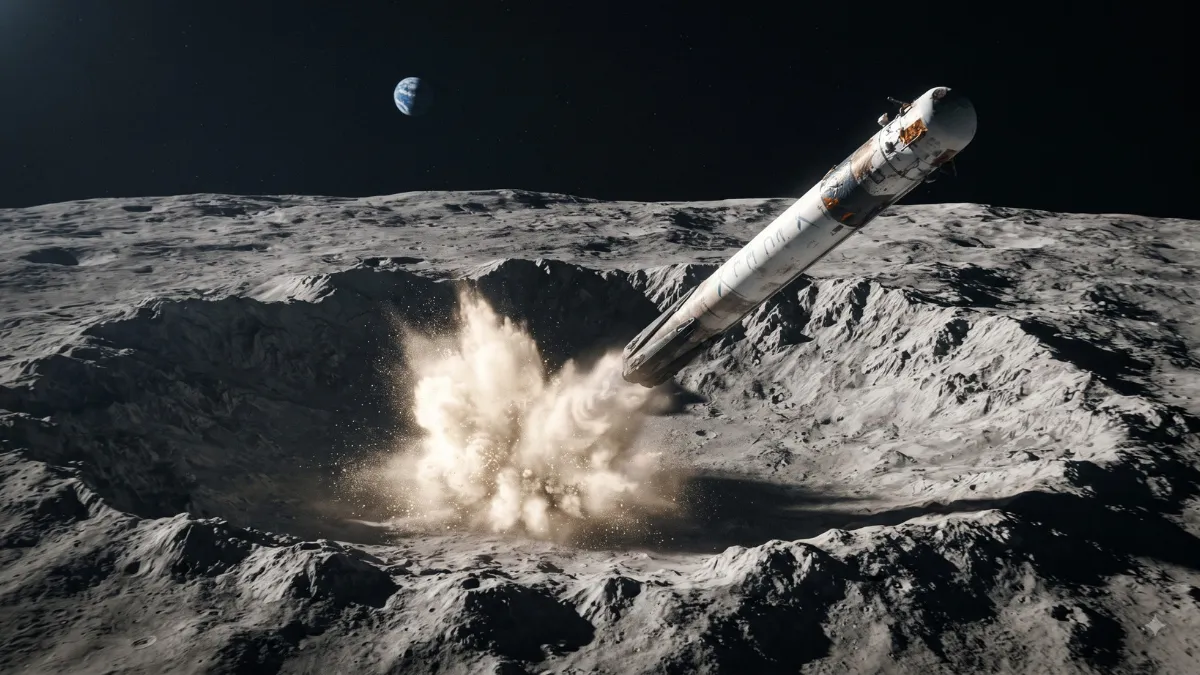
A discarded SpaceX Falcon 9 upper stage will collide with the Moon near Einstein Crater on August 5, 2026, offering scientists a rare chance to study man-made impacts.
Astronomers confirmed that a Falcon 9 rocket stage, abandoned after a 2025 lunar mission, will strike the Moon on August 5, 2026, at 06:35 UTC. The collision will occur near Einstein Crater on the Moon’s western limb.
Background & Context
The rocket stage launched Firefly Aerospace’s Blue Ghost lander and Japan’s Resilience probe in January 2025. With no fuel left for controlled disposal, it drifted in a high-Earth orbit until gravity and solar forces pushed it onto a lunar collision course.
Official Statements & Reaction
NASA scientists said the event poses no risk to Earth or future lunar missions. SpaceX confirmed the stage was abandoned safely under regulations but acknowledged natural forces altered its trajectory.
Expert Analysis & Economic/Social Impact
Researchers at Los Alamos National Laboratory and the University of Texas predict the impact will create a crater 20–30 meters wide and eject up to 12,700 kilograms of lunar dust. The plume may be visible from Earth through telescopes.
Opposing Views & Key Debates
Supporters call the crash a unique scientific experiment. Critics highlight growing concerns over deep-space debris disposal, noting the Falcon 9 stage is the size of a five-story building.
Who Is Affected?
- Astronomers: Gain rare chance to study artificial lunar impacts.
- Space Agencies: Data may improve future lunar mission safety.
- Public: Amateur astronomers may witness the plume.
- Policy Makers: Raises debate on space debris management.
Key Data & Statistics
| Metric | Value | Source |
| Impact Date | Aug. 5, 2026 | Phys.org |
| Impact Time | 06:35 UTC | Yahoo |
| Location | Near Einstein Crater | Phys.org |
| Speed | ~8,700 km/h | NewsBytes |
| Crater Size | 20–30 meters | Phys.org |
| Mass | ~4,000 kg | Phys.org |
What Happens Next?
Scientists will monitor the impact using Earth-based telescopes and lunar orbiters. Data will inform crater formation models and regolith behavior, aiding Artemis and private lunar missions.
Key Takeaways
- SpaceX Falcon 9 stage to hit Moon Aug. 5.
- Impact near Einstein Crater at 06:35 UTC.
- Crater expected up to 30 meters wide.
- Dust plume may be visible from Earth.
- Event highlights space debris disposal concerns.
Frequently Asked Questions
Q: Will the crash affect Earth?
No, it poses no risk to Earth.
Q: Where will it hit?
Near Einstein Crater on the Moon’s western limb.
Q: How big will the crater be?
Estimated 20–30 meters wide.
Q: Can it be seen from Earth?
Possibly, with strong telescopes.
Q: Why didn’t SpaceX deorbit the stage?
It lacked fuel after delivering lunar landers.
External Authoritative Sources:

About the Author
Aparna is the founder and editor of NewsDayPlus, where he covers breaking U.S. news, Social Security updates, finance, stock market trends, technology, consumer affairs, and major national events. He researches information from official government agencies, company announcements, and reputable news sources to produce accurate, fact-checked, and reader-friendly articles. His mission is to make complex topics simple, reliable, and useful for everyday readers across the United States.