
The Gates Foundation Trust is buying Home Depot while high mortgage rates continue to weigh on housing and renovations.
Bill Gates is making a huge bet on America’s home-improvement market. The Bill & Melinda Gates Foundation Trust opened a new position worth about $352.7 million in Home Depot during the second quarter of 2026, according to its latest 13F filing.
The move is turning heads because Home Depot isn’t operating in an easy environment. High mortgage rates and cautious homeowners continue to pressure major renovation spending, yet Gates’ investment arrives as the retailer shows signs of gaining momentum.
The filing shows the Gates Foundation Trust bought 1 million shares of Home Depot during the quarter ended June 30. At the end of that reporting period, the position was worth roughly $352.7 million and represented about 1% of the disclosed portfolio.
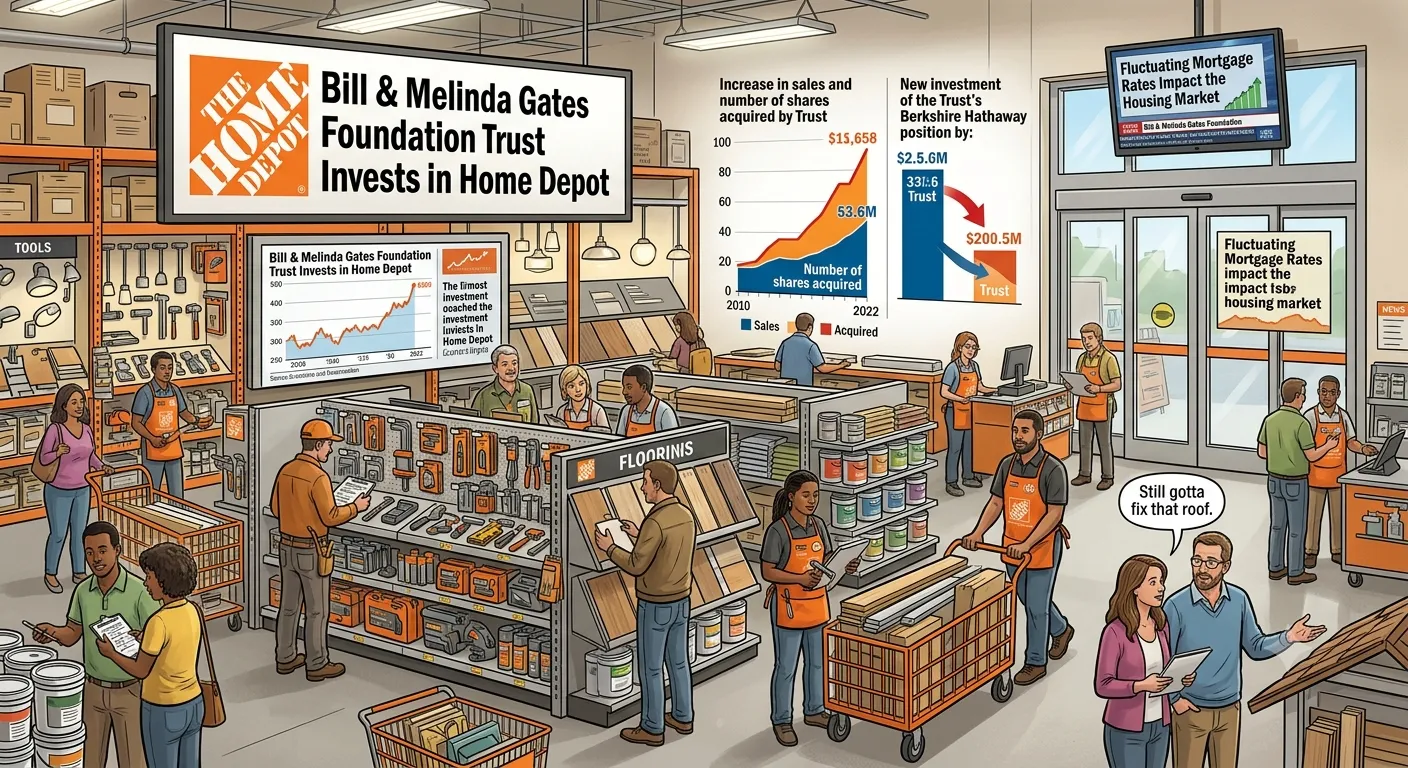
At the same time, the trust reduced its Berkshire Hathaway position by roughly $1.18 billion, cutting 2.36 million shares. Recent reporting values the Berkshire reduction at about $818 million based on the relevant transaction comparison, highlighting how closely investors are watching the portfolio changes.
That doesn’t mean Gates personally walked into a Home Depot and placed a $353 million stock order. The investment belongs to the Bill & Melinda Gates Foundation Trust, which manages a large investment portfolio to support the foundation’s long-term financial goals.
That’s an important distinction. A 13F filing tells investors what a large institutional portfolio held at the end of a quarter, but it doesn’t reveal exactly why the investment manager made every decision.
Still, the timing is fascinating.
Home Depot is operating in what company executives describe as difficult housing conditions. Yet the retailer is also showing signs that customers are continuing to spend on repairs and smaller projects, even when they hesitate to take on major renovations.
For the average homeowner, this story isn’t really about Bill Gates.
It’s about something much more familiar: the leaking roof, broken water heater, aging kitchen faucet or weekend project that simply can’t wait for mortgage rates to fall.
That’s where Home Depot’s business can be different from a company that depends entirely on people buying new houses. When something breaks, homeowners often have to fix it regardless of whether the economy feels strong.
Think of it like maintaining a car. You might postpone buying a brand-new vehicle, but when the brakes fail, you still have to deal with the problem.
The same logic can apply to a house.
Home Depot’s recent results show why investors may be paying attention. The company reported $47.9 billion in second-quarter fiscal 2026 sales, up 5.7% from a year earlier, while comparable sales increased 1.7%.
That 1.7% comparable-sales increase is especially interesting because it represents the company’s strongest comparable-sales growth since 2022, according to recent reporting.
Here’s the part that makes the Gates investment especially intriguing: the housing market doesn’t need to suddenly explode for Home Depot to benefit.
A gradual recovery in home sales, renovations and household spending could give the retailer several sources of growth. Even without that recovery, homeowners still need to maintain the homes they already own.
For millions of Americans, that creates a familiar economic tension. High borrowing costs make major projects harder to justify, but delaying repairs can eventually make them more expensive.
Skeptics have plenty of reasons to question the bet.
Mortgage rates remain a major obstacle for the housing market, and high rates can discourage homeowners from moving, remodeling or taking on large discretionary projects. Home Depot itself expects a challenging operating environment, with fiscal 2026 comparable-sales growth guidance of roughly 0% to 2%.
The stock also isn’t automatically cheap simply because it has fallen. Recent market data show Home Depot shares down significantly over the previous year, but the company still trades at a valuation that requires investors to believe future earnings can improve.
The bullish argument looks different.
Home Depot can capture spending from both homeowners and professional contractors. And when customers postpone large renovations, they may still spend money on repairs, maintenance and smaller improvements.
That makes the investment less like betting that Americans will suddenly start buying expensive kitchens again and more like betting that America’s enormous housing stock will eventually require more spending.
There’s a remarkable scale to that idea. Millions of homes don’t become less expensive to maintain simply because homeowners stop moving.
That’s the kind of long-term economic reality that can make a seemingly unpopular stock interesting to a patient investor.
But investors should avoid one common mistake: assuming that because Gates’ foundation bought a stock, everyone else should buy it too.
The foundation has a very different portfolio, time horizon and investment objective from an individual investor saving for retirement or a child’s college education.
The next few quarters will reveal whether the Gates Foundation Trust’s timing proves successful.
Investors will want to watch Home Depot’s comparable sales, consumer spending, housing activity and management’s outlook for the rest of fiscal 2026. Mortgage rates will also remain a critical piece of the puzzle because they influence whether homeowners move, renovate or simply stay put.
Another important signal will come from future 13F filings.
If the Gates Foundation Trust increases its Home Depot position, investors may see that as evidence of growing conviction. If it reduces the stake quickly, the original purchase could look more like a tactical move than a long-term bet.
For now, the filing provides one clear fact: the Gates Foundation Trust has put about $353 million behind Home Depot.
What it doesn’t provide is certainty.
Bill Gates isn’t predicting that housing will recover tomorrow. The portfolio move simply shows that someone managing billions of dollars sees enough potential in America’s home-improvement economy to make Home Depot a new position.
And that makes this trade worth watching even if you never buy a single share.
Sometimes the most revealing investment isn’t where the market is booming, but where a patient investor sees value before everyone else does.

About the Author
Aparna is the founder and editor of NewsDayPlus, where he covers breaking U.S. news, Social Security updates, finance, stock market trends, technology, consumer affairs, and major national events. He researches information from official government agencies, company announcements, and reputable news sources to produce accurate, fact-checked, and reader-friendly articles. His mission is to make complex topics simple, reliable, and useful for everyday readers across the United States.